Orion Solar Array Test Is Termed a Success
Engineering360 News Desk | March 04, 2016A 24-foot wing qualification model of the solar array for the European Service Module (ESM) of the Orion crewed spacecraft was tested at NASA Glenn’s Plum Brook Station in Ohio. The February 29 test confirmed that the array, built by Airbus Defence and Space, unfurled properly and locked into place and that all of the mechanisms functioned as expected.
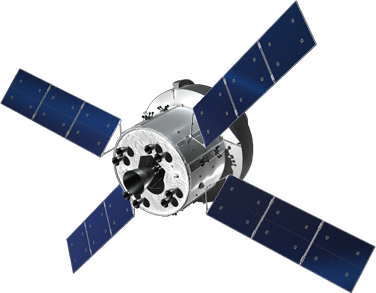 A solar array for the Orion ESM was successfully tested. Image source: Airbus Defence and Space The deployment was the first in a series of tests to verify the Orion service module can withstand the conditions of launch and ascent into deep space. The tested array involves one qualification wing, consisting of a yoke and three panels, and three dummy wings.
The final solar array will weigh in excess of 260 kg and feature four wings, each consisting of three panels with 1,242 gallium arsenide cells per panel. The almost 15,000 cells in total will provide the Orion service module with 11.1 kW of power generating capacity for its mission.
“To limit heavy stresses on the solar array, the wing must be capable of angling 60 degrees forward and backward, like that of a bird. That broad movement meant we had to design the wing with thickened solar array panels and reinforced hinges and beams, which required extensive testing,” says Arnaud de Jong, head of the Airbus Defence and Space Solar Array team in Leiden, the Netherlands.
During a Trans Lunar Injection (TLI) boost, the wing tips of the solar array are calculated to each deflect 1.06 meters. A camera on each wing tip, pointed at the Orion spacecraft, will monitor the movement. In addition to the deployment test, the test program of the qualification wing involves acoustic, vibration and shock tests, which will take place in the coming months. Flight models of the solar array are already being manufactured for a first ESM delivery at the beginning of 2017.