Simplifying the design of stellarators
S. Himmelstein | May 08, 2024Tokomaks and stellarators are the forerunner technologies in nuclear fusion development. While tokamaks rely on magnetic fields created by electric currents running through the middle of confined plasma that create instabilities and interfere with fusion reactions, stellarators can operate without such currents and can operate for indefinite periods of time. However, improved magnet designs are needed to bolster their economical and practical application.
This goal appears to have been realized by researchers from the U.S. Department of Energy’s Princeton Plasma Physics Laboratory (PPPL). A stellarator has been engineered with permanent magnets, components which are readily available and that do not require electric currents to generate fields. These simple magnets have been incorporated into MUSE as the world's first permanent magnet stellarator, embedded in a 3D-printed shell around the device’s vacuum vessel, which holds the plasma.
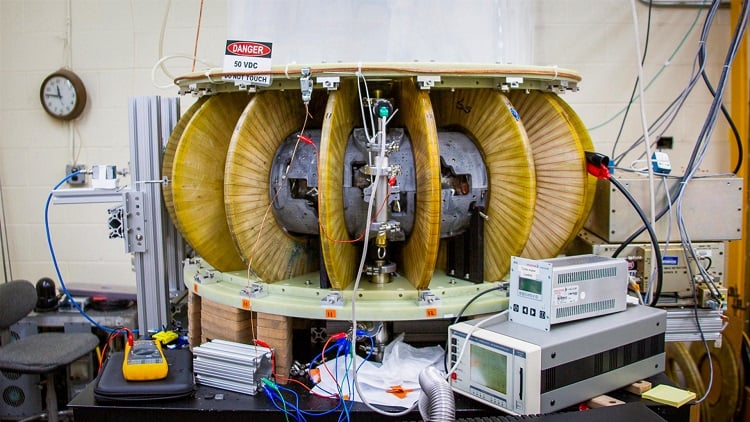 MUSE is the first stellarator to use permanent magnets. Source: Michael Livingston/PPPL Communications Department
MUSE also exhibits a high degree of quasisymmetry, which denotes uniformity of magnetic field strength despite differences between magnetic field shape versus stellarator shape. This property supports effective plasma confinement and increases prospects for the occurrence of fusion reactions. The researchers determined that the quasisymmetry optimization of MUSE is at least 100 times better than any existing stellarator.
Ongoing experiments will focus mapping the magnetic fields more precisely and measuring how the spinning plasma slows down, which is governed by the device’s quasisymmetry.