Climate Change Could Lengthen Flights, Boost Fuel Costs
Engineering360 News Desk | February 25, 2016Planes flying between Europe and North America will be spending more time in the air due to the effects of climate change, a new study has shown.
By accelerating the jet stream—a high-altitude wind blowing from west to east across the Atlantic Ocean—climate change will speed up eastbound flights but slow down westbound flights, the University of Reading’s study found.
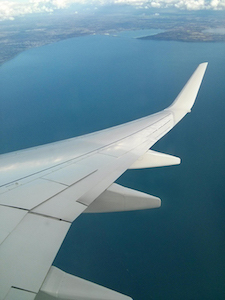 Jet-stream winds over the Atlantic Ocean are predicted to become 15% faster in winter. Image credit: Morguefile.The study, led by Dr. Paul Williams, an atmospheric scientist, calculates that transatlantic aircraft will spend an extra 2,000 hours in the air every year, adding millions of dollars to airline fuel costs and increasing the risk of delays.
"The aviation industry is facing pressure to reduce its environmental impacts, but this study shows a new way in which aviation is itself susceptible to the effects of climate change," Williams notes.
"The bad news for passengers is that westbound flights will be battling against stronger headwinds. The good news is that eastbound flights will be boosted by stronger tailwinds, but not enough to compensate for the longer westbound journeys. The net result is that roundtrip journeys will significantly lengthen," Williams says.
The study examined the effects of a doubling in the amount of carbon dioxide in the atmosphere, which many scientists believe could occur within the next few decades unless emissions are cut quickly. Under such a scenario, the average jet-stream winds along the flight route between London's Heathrow Airport and New York's John F. Kennedy International Airport are predicted to become 15% faster in winter, increasing from 77 to 89 km/hour (48 to 55 mph), with similar increases in other seasons.
As a result, London-bound flights will become twice as likely to take under 5 hours and 20 minutes, implying that record-breaking crossing times will occur with increasing frequency in future. On the other hand, New York-bound flights will become twice as likely to take over 7 hours.
Williams predicts that this effect will increase fuel costs to airlines, potentially raising ticket prices and worsening the environmental impacts of aviation. Due to the extra time spent in the air, transatlantic flights will burn an extra $22 million worth of fuel annually and emit an extra 70 million kg of CO2—equivalent to the annual emissions of 7,100 British homes, he says.