Using pressure sensors for applications beyond pressure
Seth Price | December 18, 2023Pressure sensors have uses beyond simply measuring pressure. They have many other practical applications in industry. With some design consideration, pressure sensors can be used to measure liquid level, liquid volume, fill percentage, flow rate, force, proximity and many other properties used in manufacturing, robotics and fluid flow.
Primer on measuring pressure
Before diving into the alternate uses of pressure sensors, it is important to understand a few basics on pressure measurements. The three most important concepts are absolute pressure, gauge pressure and differential pressure.
Absolute pressure: Absolute pressure is the actual pressure applied to an object.
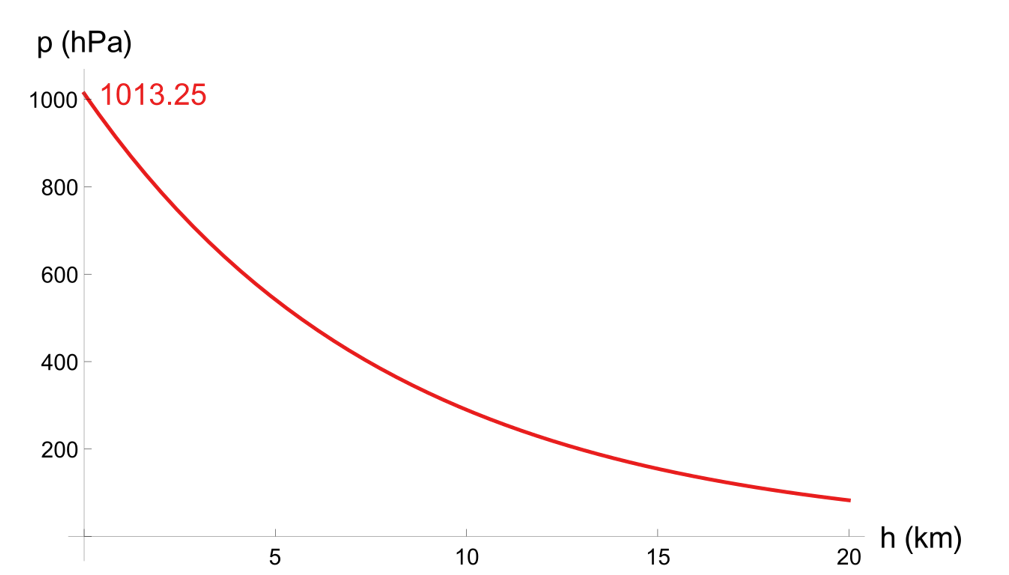
Gauge pressure: Earth’s atmosphere is applying pressure to all surfaces. Depending on the altitude, the amount of pressure varies, but at sea level, it is on the order of 14.7 psi. Gauge pressure recognizes that all objects experience the atmospheric pressure, so gauge pressure is the absolute pressure minus the atmospheric pressure.
Differential pressure: Differential pressure is simply the difference in pressure between two points in a system. It is useful for calculating pressure loss through valves, elbows and other equipment along pipelines.
All three of these have their uses. Absolute pressure is neat because the effects of weather systems and altitude are easily removed from pressure calculations. However, many pressure sensors and gauges read gauge pressure, marked in units like “PSIg.” Differential pressure is useful for finding pressure drops, or any pressure relative to another point in the system.
 Source: Spikeylegs/CC BY-SA 4.0 DEED
Level or volume
Anyone who has dived to the bottom of the pool has experienced the effects of hydrostatic pressure. The more mass of fluid above the diver, the higher the pressure the diver experiences. In other words, the deeper the fluid, the more pressure. This is governed by the equation:

Where P is the pressure, ρ is the density of the fluid, g is the gravitational constant (-9.81 m/s2 on Earth) and h is the height or depth of the fluid.
In industrial settings on Earth, typically the density of the fluid in question is known, as its chemical composition is known. By placing the pressure sensor at the bottom of a tank or storage vessel, the deeper the liquid, the higher the pressure experienced by the pressure sensor as compared to atmospheric pressure. Therefore, pressure can be used to find the fill level of storage vessels that are open or vented to the atmosphere.
In some cases, operators do not need to know the height of the tank, as they may never see the tank itself. Or, for trade secret purposes, they may not be permitted to know the exact amounts or size of the equipment used. Instead, it might be useful to convert the fill level to a percentage and provide the operator with a fill percentage. In other cases, the volume of liquid must be known, especially for safety purposes. One can calculate the volume of the tank through standard geometry, using the fill height as one of the important dimensions.
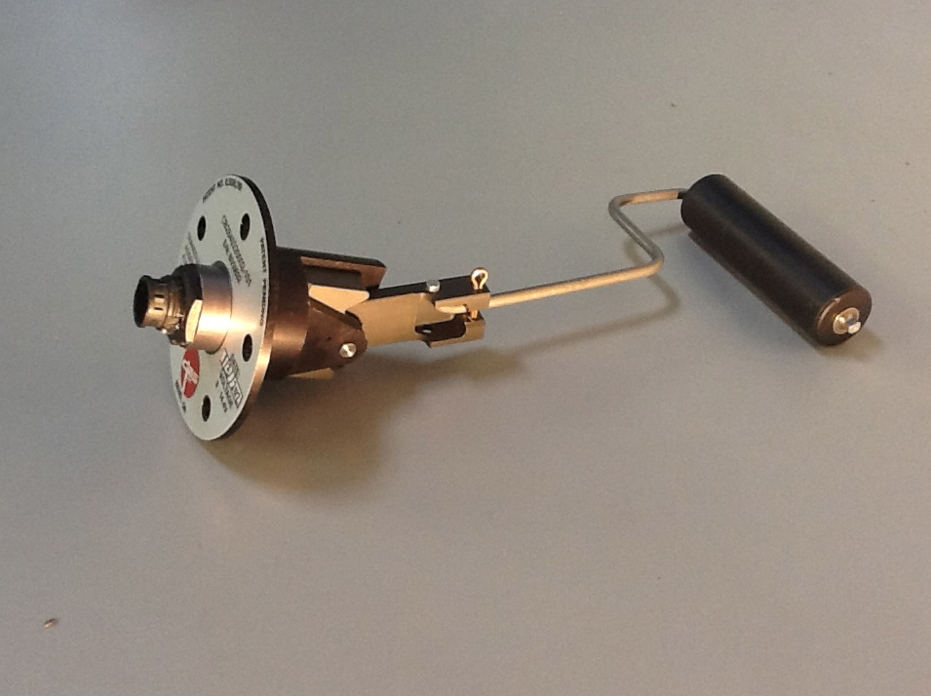
As compared to float sensors, pressure sensors have no major moving parts. There’s no armature to get stuck, bent or jammed. If the armature gets stuck, the liquid level may rise above the float level, as it is not free to float. This can lead to overfilling of tanks and vessels. Compared to resistive strips, where the liquid pressure pushes two conductors together, pressure sensors can provide higher reliability. Resistive strips are prone to small holes or tears where a single droplet of moisture can cause a false reading. In this case, the reading will lead to underfilling of tanks, perhaps draining a reactant from a tank without the operator’s knowledge.
 Source: Stphiliben/CC BY-SA 3.0 DEED
Flow
Another common use for pressure sensors is to use them to measure liquid flow through a system. In order to take a flow measurement, a differential pressure sensor is placed inline with the pipe, and an orifice plate is placed in between the two pressure sensors. These are sometimes referred to as “orifice meters,” which is a little misleading, as the orifice is known, not measured.
In this setup, the orifice plate has a hole that represents the smallest diameter of the system. If the pressure drop (as calculated from the difference in pressure) is known, and the area of the orifice is known (it is often stamped with the orifice diameter), the flow can be calculated using the equation:
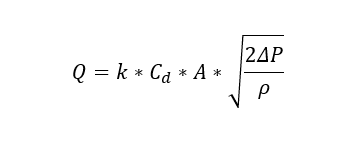
Where Q is the flow rate, k is a constant related to the system, Cd is the discharge coefficient, A is the area of the orifice, ρ is the density of the fluid and ∆P is the pressure difference.
Some of these quantities can be determined experimentally. It is also worth noting that some of these parameters are temperature dependent, so it can be complicated to calculate initially. However, once the properties are known and adjusted for temperature, it can be an accurate way to measure flow.
In terms of maintenance, the orifice is under high stress. Over time, the diameter can expand as erosion eats away at the edges. To combat this, some of the orifices are “jeweled” or hardened, either with a ceramic coating or heat treatment, depending on the particular application. The plate is also relatively easy to replace, though good ones are not cheap.
Force
Ultimately, pressure is merely force divided by area. Therefore, pressure sensors can be used as a way to measure force, given the surface area of the sensor. Perhaps one of the most common modes of force sensing is a “go/no go” type switch, where the pressure sensor is used to determine if an object is present. Sometimes, this is used as a safety switch, where if the pressure sensor determines a person is standing somewhere unsafe, a machine will not operate.
Force sensing is also useful for any sort of materials handling application. Consider a robotic gripper. The grip needs to be strong enough to grasp the object and prevent it from falling, but not so strong as to damage the item. The best way to do this is to determine the amount of grip (force) required, based on the statics and the dynamics of the situation using force balances and free body diagrams. This can be done by computer, using the feedback from the pressure sensors embedded in the gripper.
Final thoughts
In instrumentation, if a device changes in response to a physical or chemical change, it can be used as a sensor, at least at a low-resolution or primitive level. Everything else in instrumentation is about increasing the resolution, sampling rate and sensitivity of the sensor. Pressure sensors, like many other sensors, can be used for other purposes besides measuring pressure. When decommissioning a process or experimental system, engineers should pay close attention to the state of the pressure sensors, as they might be useful in future projects, even if pressure is not the direct quantity that needs to be measured.