3D Printed House and Car Form Energy System
Engineering360 News Desk | February 17, 2016One of the world’s largest 3D-printed structures, a 5,928-cubic-foot building designed by Skidmore, Owings & Merrill (SOM) to produce and store renewable power, made its debut at the International Builders’ Show in Las Vegas. The product of the Additive Manufacturing Integrated Energy demonstration project—a research and design collaboration with the Oak Ridge National Laboratory—the structure is an attempt to demonstrate the use of bidirectional wireless energy and high-performance materials to achieve independence from the power grid at peak-demand times.
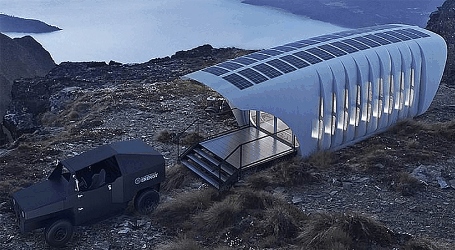 C-shape forms condense many functions of a conventional wall system into an integrated shell. Image credit: SOM.The building connects wirelessly to a natural-gas-powered hybrid electric vehicle—also 3D printed—to create an integrated energy system. Power can flow in either direction between the vehicle and building, allowing the car to power the building when the sun is not shining.
SOM used large-scale 3D printers to construct C-shape forms that condense many of the functions of a conventional wall system into a shell. Integrated into the roof are flexible photovoltaic panels that work with the vehicle's natural gas-powered generator to supply energy for lighting and a central kitchen. In addition to supplementing the vehicle energy source, the panels also charge the enclosure’s battery when fixtures are not in use.
The structure's ratio of insulated solid surfaces (79 percent) to glassed areas (21 percent) results in an efficient energy-conserving enclosure. The structure’s interior ribs are designed to host high-efficiency, atmospherically insulated panels.
According to SOM, 3D printing proved invaluable in creating complex, organic geometries optimized to reduce localized stress and mitigate turbulent exterior airflow. Full-scale load testing was done to confirm the structure’s performance.
The project partners hope the integrated approach to energy generation, storage and consumption will help generate solutions for the modern electric grid, which faces challenges ranging from extreme weather events to how best to incorporate growing renewable energy use.