
Fishing for uranium resources
S. Himmelstein | November 02, 2023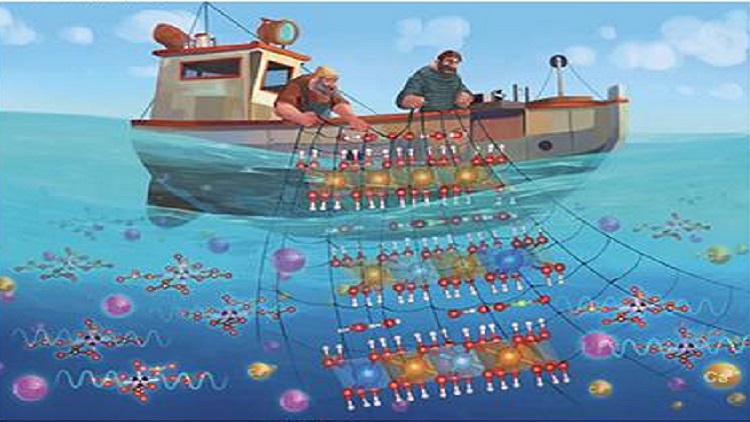 The inexpensive material harvests U from seawater. Source: Energy Adv., 2023,2, 1134-1147
Mining uranium (U) to fuel nuclear power systems is typically a terrestrial activity and limited to a finite number of deposits. Although the U concentration in seawater is only about 3 micrograms/liter, the quantity dissolved in the world’s oceans is estimated to amount to 4.5 billion tons; the current conventional terrestrial resource is estimated to amount to about 17 million tons. The scope for harvesting may extend offshore to cost-effectively increase the supply of U with selective layered double hydroxide (LDH) extraction materials.
Researchers from the University of New South Wales (Australia), the Australian Nuclear Science and Technology Organisation and the Illinois Institute of Technology tested different LDH formats tailored to capture U from the marine environment. Lanthanide dopants, neodymium, europium and terbium were added to LDHs and evaluated by scanning transmission electron microscopy and scanning electron microscopy.
Adding neodymium to LDHs improved their ability to selectively capture uranium from seawater without also collecting sodium, calcium, magnesium and other more abundant but unwanted elements. Under seawater conditions, the removal of U occurred through a process where U atoms formed complexes on the surface of LDHs by replacing nitrate ions in the adsorbent material layers with uranyl carbonate anions from the seawater.
The addition of neodymium and other lanthanide elements to the LDH structure renders the chemical bonding between metal atoms and oxygen in the LDH more ionic and improves the collection of U. In addition to opening a new route to nuclear fuel production, the materials described in Energy Advances offer potential to remove U from radioactive wastewater at nuclear power plants.



Do they realize that they don't have to "mine" (or fish for) U? If the world converts to Gen IV (fast) nuclear reactors, I understand that there is enough depleted U (U-238) already on hand to provide the fuel for decades. Plus Th and "waste" from the current thermal reactors can also be used.