
How e-bikes and e-scooters are transforming cities
Peter Els | October 09, 2023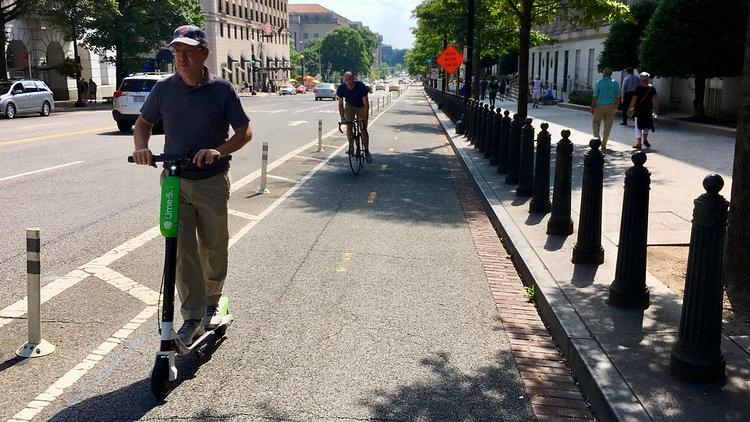 Source: Steven Vance via Flickr/CC BY-NC-SA 2.0
As the world grapples with the consequences of climate change and increasing traffic congestion, commuters are searching for convenient, sustainable and cost-effective alternatives to traditional urban mobility.
Micromobility – especially electric scooters and bikes – is ideally positioned to become the most convenient and reliable transit in dense, urban environments. Not only do these modes promise a reduction in traffic congestion and greenhouse gas emissions, but also offer convenient and cost-effective, short-trip transportation that is available to all communities.
Hence, the phenomenal growth in micromobility, driven by shared transportation business models. Even though the first docked bike-sharing program was only launched in 2008 in Hangzhou, China, the global electric bike market was already worth $37.47 billion in 2022. In the U.S. alone, more than 880,000 e-bikes were sold in 2021, compared with 608,000 electric cars and trucks. That’s up from 450,000 e-bike sales in 2020.
Fueled by consumer demand for convenient, cost-effective and efficient transportation, environmentally-friendly transit is reshaping the way people move within cities, providing a glimpse into a more sustainable, efficient future of urban transportation for all.
Sustainable mobility growth
These electric two-wheelers are rewriting the rules of urban transportation. Communities that are underserved by traditional public transit, like subways or buses, increasingly view e-bikes and e-scooters - especially when offered for hire by one of the many shared services - as viable means to get where they need to be. A recent review of Lime’s service in London, undertaken by global transport consultancy Steer, showed the shared operator’s e-bikes significantly improved accessibility for Londoners.
The study, spanning Lime’s operations in London from January 2019 to March 2023, showed that over 1.25 millions riders undertook more than 12 million e-bike trips, with usage increasing on average by 10% a month. What is more, 50% of London’s Lime e-bikes were rented in areas with high levels of poverty, demonstrating that the service was heavily utilized by those who may lack different transit options.
Of course, the importance of micromobility in urban settings extends even further than its socio-economic impact on communities. The carbon dioxide (CO2) emissions produced by an e-scooter are around 5% of those from an electric car, and the emissions associated with manufacturing are similarly minute. Per some estimates, switching to an e-bike for last-mile urban transportation could reduce CO2 emissions by 225 kg each year.
Micromobility is changing the urban landscape, for better and worse
Despite the many advantages of micromobility, in many places, e-scooters and e-bikes are coming into conflict with pedestrians, drivers and even each other. For instance, Paris recently banned rental scooters following a vote on the matter.
Due to their popularity, the “trottinettes,” as the French call them, had become a massive problem in Paris. First introduced in 2018, within a few years Parisians were surrounded by no fewer than 15,000 e-scooters, many of them cluttering the roads and sidewalks as they were abandoned after completing a trip.
Coupled with dozens of deaths each year, city officials have decided to prioritize bicycles. New bike lane construction has been expansive in recent years, intended to overcome bike traffic jams and also add capacity ahead of the 2024 Olympics.
The Parisian ban on rental scooters is symbolic of the nuisance other places have experienced. Although the simple answer seems to be to install more scooter dock stations, the estimated number required is unfathomably high. For example, in the Steer study of Lime’s operations in London, 50% of respondents said they would not walk further than 200 m to pick up or drop off a bike at a parking station. This means around 25 parking stations are needed per square kilometer, equating to 10,000 new stations across London alone.
But it is not only the problem of randomly abandoned e-bikes and scooters that needs an urgent solution: safety concerns are rising with the steady increase in user injuries and even fatalities. While the free-floating model is a problem, experts say the biggest hurdle facing the adoption of e-bikes on a large scale is infrastructure. Most cities–especially, low-income neighborhoods, do not have user-friendly planning that makes people feel safe to be traveling on any type of last-mile transit.
A Virginia Tech study found that nearly half of all e-scooter crashes could be attributed to risky infrastructure - situations where the rider must navigate transitions between terrain such as gravel to pavement to grass, or places where fixed infrastructure, such as signs, interfered with travel. Scooters must rely on either automotive roadways or pedestrian sidewalks, which causes other conflicts.
New infrastructure abounds
As a result, a number of organizations and interested parties are advocating for more dedicated spaces for last-mile transit. In the U.S., the national nonprofit PeopleForBikes seeks to address this by lobbying for safer speeds, protected bike lanes, traffic reduction and more inclusive road planning to make cities more bike-friendly.
Cities such as Atlanta and Santa Monica, California, have seen their micromobility infrastructure expand. After Atlanta saw four scooter deaths in a close amount of time, its mayor pledged to install barriers, painting and other tools along its 188 miles of bike lanes. Santa Monica is planning 19 new miles of bike lanes, many of them completely separated from roadways, after it learned half of its micromobility commutes were replacing a car trip.
New York City is among those considering congestion pricing, wherein vehicles pay to drive through its most busy streets, especially in Manhattan. A critical response to this seems to encourage micromobility. The government of Mayor Eric Adams has been converting abandoned newsstands into transit hubs for bikes and scooters.
Summary
As cities evolve, embracing new technologies and mobility solutions, e-bikes and e-scooters stand at the forefront of a greener, more efficient future. These compact electric vehicles are emerging as powerful tools for addressing the complex challenges posed by urbanization, including traffic congestion, pollution, and the need for inclusive and sustainable transportation.
Yet what we've seen in recent years is that cities need to embrace these technologies and adapt the environment to encourage their growth - or otherwise consider abandoning them altogether. There seems little room for a middle ground. To fully realize the potential of micromobility, it is imperative that cities invest in infrastructure, enact supportive policies and collaborate with industry stakeholders.




In more ways than one.
Abandonment of derelict devices has become a major headache for a number of cities. If you only look at one link, choose the first one.
https://www.theatlan
https://www.dailymai
https://electrek.co/
https://memosandmirt
https://www.reddit.c
https://johnstonsunr
https://www.orlando.