UK facility advances circular economy for plastic lab waste
S. Himmelstein | October 26, 2023A pilot plant established at the University of Bath, U.K., can recycle up to 60% of plastic waste generated at research and industrial laboratories back into new lab consumables. LabCycle, a startup cofounded by the university, envisions scaling up its technology to recycle waste from healthcare, research and commercial labs that is currently incinerated or sent to landfill.
Currently, less than 1% of this waste associated with reliance on single-use plastic petri dishes, pipette tips and other equipment is currently recycled. The new processing scheme addresses this issue by converting used equipment into high grade plastic pellets, which can be used to make new tubes and petri dishes.
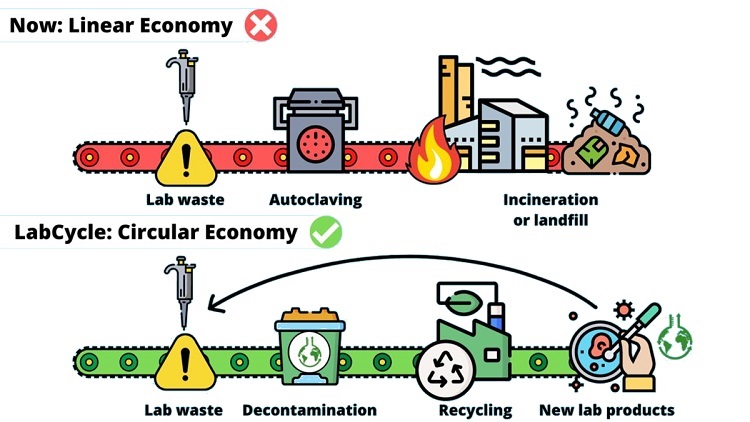 A circular economy approach can supplant the linear economy to minimize waste generation and resource consumption. Source: LabCycle
A combination of chemical disinfection and mechanical treatments are applied to remove biological and chemical contaminants, after which the material undergoes mechanical recycling. The process does not require the waste to be autoclaved, thereby reducing energy consumption and the need for process heat. Water usage is also minimized through recycling, further reducing the environmental impact.
The university’s Innovation Centre for Applied Sustainable Technologies has tested the properties of recycled polystyrene, polypropylene and polyethylene terephthalate and concluded that the polymers are suitable to make new lab consumables.