Microsoft Tests Underwater Datacenter
Engineering360 News Desk | February 10, 2016Microsoft has concluded a three-month test of a datacenter placed on the seafloor to assess the feasibility of using the ocean to cool and—in the future—perhaps power these facilities. Project Natick involved placing a 7-by-10-foot, 38,000-pound container with computing power equivalent to 300 desktop PCs on the seabed off the California coast. Using cameras and sensors, staff recorded data such as temperature, humidity, the amount of power being used for the system and the speed of ocean currents.
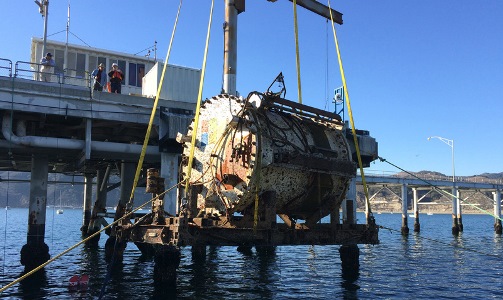 Crews lift the datacenter from the ocean. Image credit: Microsoft. “This is speculative technology, in the sense that if it turns out to be a good idea, it will instantly change the economics of this business,” says Norm Whitaker, who heads special projects for Microsoft Research NExT.
As the backbone of cloud computing, datacenters contain groups of networked computers that require significant amounts of power to store, process and distribute information. Part of what makes the ocean a potentially attractive location for datacenters is the ability to generate some or all of the facility’s power requirements from wave or tidal activity (although for the test run, the datacenter linked to the existing electrical grid).
Cooling is another consideration for operators. Datacenters typically run up substantial costs running chiller plants to keep computers from overheating. The deep sea’s cold environment could make datacenters less costly and more energy efficient.
According to Microsoft, the project shows it’s possible to deploy underwater datacenters faster. In the case of Project Natick, building the vessel that housed the experimental datacenter took 90 days. While every datacenter on land is different and needs to be tailored to varying environments and terrains, Microsoft says that underwater containers could be mass produced for similar conditions underwater.
The ability to build datacenters quickly and disperse them widely points to another potential advantage of an underwater datacenter scheme: reduced "latency." When datacenters are located closer to where people live and work, downloads, Web browsing and games all are faster.
According to Microsoft, the project’s next phase could include a vessel four times the size of the test container with as much as 20 times the computing power. The team is also evaluating test sites for the vessel, which could be deployed for at least a year underwater and powered by a renewable ocean energy source.