
Turning potato chip bags into energy-saving cooling films
Marie Donlon | September 15, 2023Researchers from the University of Bayreuth in Germany are turning the films composed of aluminum-plastic laminates (APL) used in the packaging of potato chips, roasted and powdered coffee, milk, fruit juices and other foods into films for cooling systems.
Composed of several polymer layers as well as an aluminum layer designed for protecting products like potato chips from sunlight, heat, moisture and oxygen, the materials was used to develop an upcycling process for potato chip bags that includes the development of cooling systems.
To develop the cooling system, the researchers applied a clear polymer layer to the aluminum layer of APL packaging, which increased the radiation of thermal energy offered by the mirror-like reflective surface of the aluminum layer, resulting is a reportedly powerful cooling system.
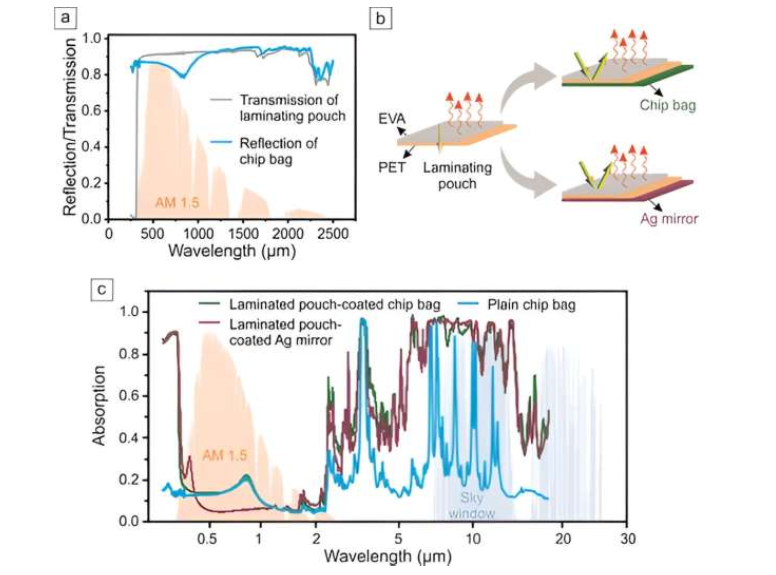 a) Solar reflection and transmission of a plain chip bag and laminated pouch foil, respectively. (b) Schematic shows the concept of passive daytime cooling with a laminated pouch-based cooling device. (c) Optical property of a laminated pouch (∼80 μm)-covered chip bag and Ag mirror. The AM 1.5 solar intensity spectrum (highlighted in orange) and atmospheric transparency window (highlighted in blue) were plotted as the background. Source: ACS Sustainable Chemistry & Engineering (2023). DOI: 10.1021/acssuschemeng.3c00683
The researchers explain that the coating produces cooling foils that can be applied to the surfaces of products like umbrellas, blinds and awnings, and subsequently prevent the heat produced from glaring sunlight. Simultaneously, the ambient heat is diverted to the cool space without requiring an external energy supply.
This process, dubbed passive daytime cooling — wherein temperatures below the ambient temperature are reached, even in the face of intense sunlight — is achieved when the materials used meet certain optical requirements, scattering or reflecting as much of the sunlight as possible with wavelengths between 0.3 micrometers and 2.5 micrometers. Meanwhile, in the wavelength range between 8 micrometers and 13 micrometers — dubbed the sky window — the materials emit as much thermal energy as possible into space as infrared radiation.
The Bayreuth researchers reportedly demonstrated in the lab that roughly 87% of the sunlight was reflected by the aluminum layer of the potato chip bag while the polymer coating of the new cooling foils improved the radiation in the wavelength range of the sky window and emitted heat directly into space.
The process is detailed in the article, Passive Daytime Cooling Foils for Everyone: A Scalable Lamination Process Based on Upcycling Aluminum-Coated Chips Bags, which appears in the journal, ACS Sustainable Chemistry & Engineering.
Recycling used chip bags is patently stupid.
Adding another film layer to the uncut material used to make chip bags more suitable for reflective purposes is a fine idea.