
Self-destructing robot leaves behind only an oily puddle
Marie Donlon | August 29, 2023A robot capable of self-destructing — leaving behind oily residue as the only trace of its existence — has been developed by a team of researchers from Seoul National University in South Korea.
To develop this self-destructing robot, the researchers applied a substance to silicone resin that when exposed to ultraviolet (UV) light will release fluoride ions. The researchers suggest that when the built-in UV light emitting diodes (LEDs) are triggered by the robot’s operator, subsequently heating the substance, the robot disintegrates, decomposing in under two hours and leaving only an oily residue behind.
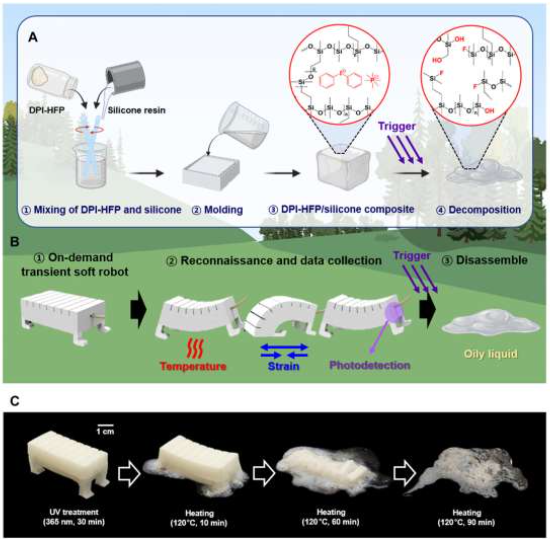 Overview of transient DPI-HFP/silicone composites and a lifetime configurable soft robot. (A) Fabrication process of a transient DPI-HFP/silicone elastomer composite and its decomposition response upon application of a trigger. (B) Illustration of a lifetime configurable gaiting robot capable of sensing the surrounding environment and disassembling the entire system via trigger application whenever necessary. (C) Time-lapse image of the gaiting robot undergoing decomposition at 120°C for 30 min after exposure to UV light (365 nm). Source: Science Advances (2023). DOI: 10.1126/sciadv.adh9962
This, according to its developers, could potentially ensure that sensitive data carried on-board robots — used in surveillance, scouting and transport applications, for instance — would not fall into the hands of an enemy. Further, this self-destructing robot could potentially be used to conduct search missions in dangerous locations or environmentally hazardous areas where retrieval would be challenging if not impossible.
"We fabricated a highly deformable and fully degradable gaiting robot and demonstrated it in a hypothetical scouting scenario," the researchers explained. "Under certain scenarios wherein disintegration is desired, including mission completion, discovery by enemies, or disposal requiring volume reduction, the robot can be exposed to UV light and disintegrate into an unrecoverable form."
An article detailing the self-destructing robot, "Lifetime-configurable soft robots via photodegradable silicone elastomer composites," appears in the journal Science Advances.



We used to call those Triumphs or Harley-Davidsons.
In reply to #1
Harleys just marked their spot.
In reply to #2