A sweet way to stretch flow battery longevity
S. Himmelstein | August 17, 2023The reliance of current flow battery designs on costly and scarce minerals such as vanadium has prompted researchers to explore the utility of more common alternatives. Researchers from Yale University and U.S. Pacific Northwest National Laboratory report sweet success with a simple sugar derivative that effectively accelerates the chemical reaction that converts energy stored in chemical bonds to release energy to power an external circuit.
The derivative of starch — β-cyclodextrin — was demonstrated to boost battery longevity and capacity; the ratio of chemicals in the battery was optimized to enable attainment of 60% peak power. After cycling the flow battery for more than a year, the system barely lost any of its activity to recharge. The research
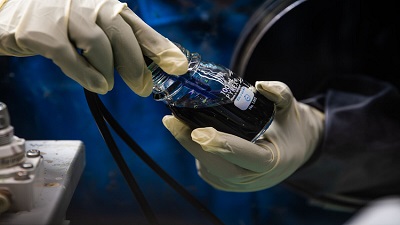 The experimental flow battery electrolyte has shown long life in a laboratory setting. Source: Andrea Starr/U.S. Pacific Northwest National Laboratory reported in Joule documents the first laboratory-scale flow battery experiment to record more than a year of continuous use with minimal loss of capacity.
Dissolved in the liquid electrolyte, the β-cyclodextrin additive is also the first to speed the electrochemical reaction that stores and then releases the flow battery energy via homogeneous catalysis. This means the sugar does its work while dissolved in solution, rather than as a solid applied to a surface.
The need for these flow battery facilities is expected to grow with increased electricity generation from renewable energy sources. These intermittent power sources require a place to store energy until it’s needed to meet consumer demand.