Injection molding: Greener, smarter, more efficient
GlobalSpec News Desk | July 17, 2023The booth shows a wide range of solutions for different industries and requirements. At the Expert Corners, interested visitors will also find information on how complex production processes can be simplified — regardless of the specific area of application: from the automotive industry to technical molding, to packaging and medical, ENGEL provides answers to the challenges of the future.
Everything under control with smart machines and assistant systems
The performance of all iQ smart assistant systems, available as part of ENGEL’s inject 4.0 program, will be demonstrated at the fair with a production cell based on an all-electric ENGEL e-mac 265/80 injection molding machine with a clamping force of 80 tons. The cell is equipped with a four-cavity mold for the production of PBT automotive connectors. The total shot weight of 28 grams and a specific consumption of 0.8 kWh per kilogram of processed material do not affect precision and repeatability. An ENGEL viper linear robot in the new size 4 will remove the components from the mold and place them on the conveyor belt.
The all-electric drives of the e‑mac machine contribute to this high degree of energy efficiency, further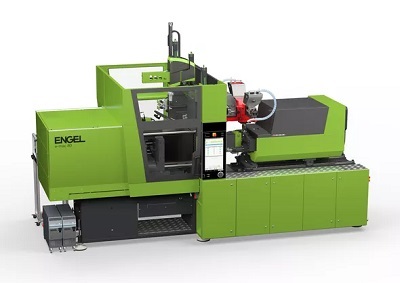 Source: ENGEL enhanced by the e-flomo and e-temp temperature control technology integrated with the smart iQ flow control assistant system, which saves 4,000 kWh in one year of operation at full capacity. The ENGEL e-flomo temperature-control water manifold system monitors and regulates the flow rate, pressure, temperature and temperature differences. Based on these parameters, iQ flow control assistance actively regulates the temperature difference in the individual circuits. This means that the thermal conditions in the mold remain constant at all times, even if there are fluctuations in the system. The result is very high repeatability and minimum cooling water and energy consumption. The integration of e-temp temperature control units into the CC300 control unit of the injection molding machine via OPC UA delivers an additional energy saving. In the integrated ENGEL solution, the flow rate of the temperature control water pumps is automatically adapted to match the actual process demand.
Change of pace in packaging
An ENGEL e-speed 280/50 injection molding machine is the heart of the production cell. ENGEL specifically developed this hybrid machine with its electrical clamping unit and hydraulic injection unit for the high performance requirements of thin-wall injection molding. The high-performance injection unit achieves injection speeds up 1,400 mm per second at a maximum injection pressure of up to 2,600 bar when processing small shot weights with an extreme wall-thickness to flow path ratio. This makes it the most dynamic injection unit on the market worldwide.
To process rPET, ENGEL combines the new injection unit with a plasticizing unit from in-house development and production specifically designed for processing recycled material. During plasticizing and injection, the viscosity of the PET is configured for thin-wall injection molding. The new ENGEL e-speed supports the processing of arbitrary recycled materials up to 100% rPET. Moreover, the mold is able to process different types of IML labels in order to allow customers to adapt to global trends and comply with different standards and recommendations.
Precision and efficiency for liquid silicone rubber
The production cell at the ENGEL stand leverages the quality and efficiency potential for the production of blade valves with a blade diameter of 7 mm in the best possible way. It combines an e-victory injection moulding machine and smart digital assistance with NEXUS's innovative mold and plasticizing technology. Production is fully automated in a 64-cavity mold with an ENGEL easix articulated robot and an integrated vision control system for 100% quality control.
Featuring tie-bar-less servo-hydraulic clamping and electric injection units, the injection molding machines from the ENGEL e-victory series are predestined for precision applications with LSR. The electric ENGEL injection unit ensures high-precision injection. The excellent accessibility and the space available in the mold area are unique on this tie-bar-less injection molding machine. Where multiple-cavity molds are used, smaller machines than the mold size would normally dictate can be used in many cases. This keeps both investment outlay and operating costs low. The moving platen follows the mold precisely while clamping force is being built up, which results in excellent platen parallelism. Patented force dividers ensure that the clamping force is distributed evenly over the entire platen face. Even for large multiple-cavity molds, the cavities near the outer edge of the platen are kept closed with exactly the same clamping force as those nearer the center.
The ENGEL easix articulated robot ensures optimum space utilization on the automation side and also requires very little headroom. It connects the injection molding machine with camera-based quality control and the discharge station and adapts flexibly if additional process units need to be retroactively integrated upstream or downstream of the injection molding process.
It is in cases of batch fluctuations in the raw material, or environmental conditions, for example, due to weather conditions, that digitalization comes into its own. Equipped with the iQ weight control smart assistance system from ENGEL's inject 4.0 portfolio, the injection molding machine continuously analyzes the injection profile and readjusts quality-relevant process parameters in the same cycle whenever deviations from the reference cycle occur.
Experience these and other injection molding innovations offered by ENGEL at Plast 2023, Hall 24, stand C82.