
Dry run testing of hydropower systems in the lab
S. Himmelstein | August 15, 2023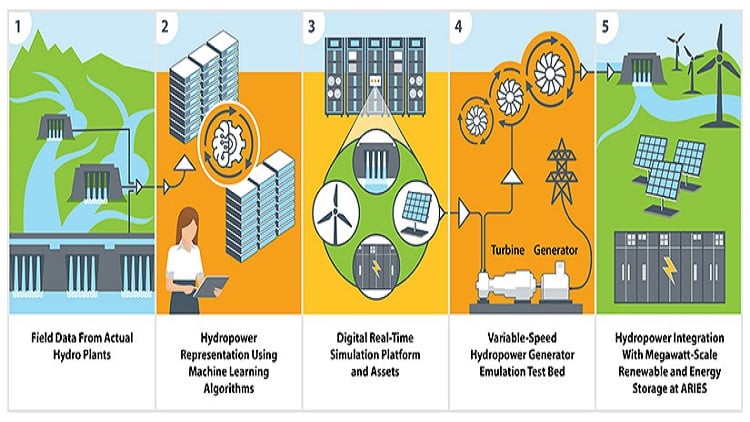 Combined with ARIES, the hydropower emulation platform can be used for prototyping controls and evaluating hydropower-specific technology. Source: Tara Smith, NREL
Power engineers can now gauge and improve the reliability and resiliency of complex hydropower systems without getting their feet wet. Field data from actual hydropower plants, mathematical models and hardware can be used to recreate hydropower plants in a virtual laboratory setting engineered at the U.S. National Renewable Energy Laboratory (NREL).
The Real-Time Hydropower Emulation Platform enables evaluation of how different hydropower plant designs with capacities up to 2.5 MW are likely to perform in the real world and in real time and is particularly useful in assessing the utility of power electronics for enhanced control over plant output. The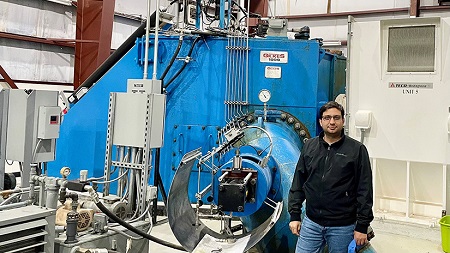 The platform relies on modeling, real-world data and a few mechanical components to explore hydropower system performance. Source: Rob Hovsapian, NREL system provides a low-cost, low-risk way to test such new hydropower technologies and grid configurations without the economic and time costs incurred in constructing such complex facilities.
"It's a significant addition to our emulation platform" said Rob Hovsapian, a senior research advisor at NREL, who helped build the emulation platform. "Hydropower needs to live with the changing grid, and we want to make it a better resource in terms of flexibility and reliability."
The platform has been applied to field data from hydropower plants operating in the remote Alaskan city of Cordova. Machine learning tools were used to design software representations that could realistically imitate a hydropower plant, including its electronic controls, turbines, hydraulic and mechanical circuits, and water flows in real time.
Researchers can also tap into NREL’s Advanced Research on Integrated Energy Systems (ARIES), the largest digital grid simulation platform devised by the U.S. Department of Energy, to discern how new hydropower designs might integrate into various grid systems. With ARIES, the hydro emulation platform could mimic how hydropower plants might pair up with energy storage and other renewable energy technologies to provide more reliable energy to a grid. New software can also be linked to actual hardware, like rotating machines that represent a hydropower plant’s rotating turbine, to get as close as possible to replicating a real-life plant in the safety of a controlled lab environment.



