Flexible sensors stretch greenhouse gas detection capability
S. Himmelstein | July 20, 2023The complexity, bulk and limited spectral ranges of flat sensor arrays and optics currently used in cameras undermine the utility of drones and satellites in monitoring greenhouse gas emissions. A new flexible photodetector has been designed by researchers from the University of Melbourne (Australia) and the University of California at Berkeley to overcome these gas detection challenges.
The sensor can detect visible to long-wave infrared radiation and covers the full spectrum of greenhouse gases without the need for complex optical components. The ability to operate at room temperature eliminates the need for cryogenic cooling, which is required for typical mid-wave infrared cameras.
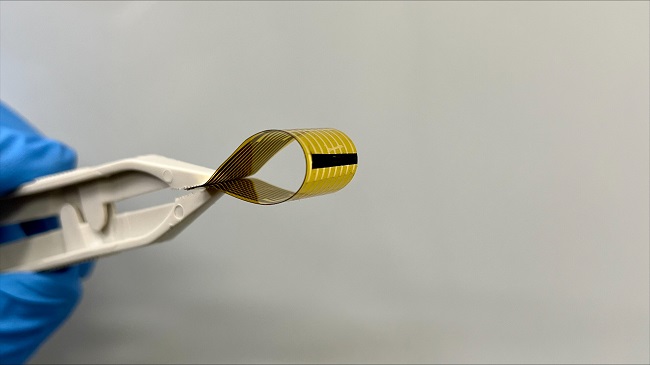 Simple to produce and scalable, the flexible photodetector covers the full spectrum of greenhouse gases without the need for complex optical components. Source: University of Melbourne
Vanadium oxide nanospheres grown as a powder are mixed with alcohol, forming a suspension that can be dropped onto flexible circuitry at low temperatures, negating the need for a bridge, vacuum pack or complex optics.
The photodetectors withstand significant bending and maintain their photoresponse with minimal standard deviation even under repeated bending and releasing, enabling fabrication of flexible infrared sensors and curved focal plane detectors. The devices described in Advanced Functional Materials were demonstrated to deliver an operating wavelength range from the visible to the long wave infrared.