These silicon cells provide photovoltaic flexibility
S. Himmelstein | August 10, 2023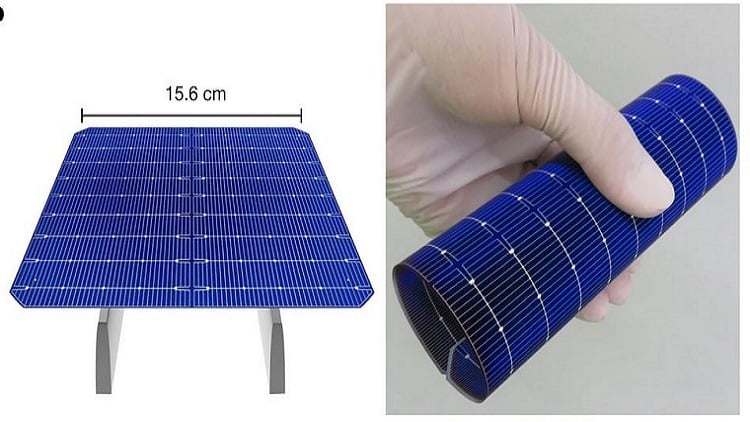 These flexible silicon solar cells are suitable for building- and automotive-integrated photovoltaics. Source: Nature, 617, 717–723 (2023)
Conventional silicon solar cells are valued for their power conversion efficiency but are limited in application to uneven or flexible surfaces due to their inherent rigidity and brittleness. An international research team has overcome this barrier to wider deployment by devising foldable crystalline silicon wafers for use in flexible silicon heterojunction (HJT) solar cells.
HJT cell technology is ideal for manufacturing flexible solar cells, as it eliminates edge warping caused by inner stress during the firing process. The wafers were developed with blunting treatment, a technique commonly used to round a wafer's edges, in order to prevent chipping and cracking during processing. The process resulted in a transition of the fracture mechanism from intrinsic brittle cleavage fracture to shear banding with steps and cracks.
As reported in Nature, 180 μm Czochralski n-type crystalline silicon wafers were used to create textured wafers with a thickness of 60 μm. The devices were textured in a 2.1-vol% alkali water solution at 80° C for 10 minutes to form microscale pyramids on the surfaces and then cleaned in 2.0% hydrofluoric acid water solution for 3 minutes to etch the surface oxide.
Two HJT cells with thicknesses of 65 μm and 55 μm were then fabricated. The first cell had a power conversion efficiency of 23.31%, an open-circuit voltage of 0.752 V, a short-circuit current density of 0.09 mA/cm2 and a fill factor of 82.40%. The second cell hit an efficiency of 23.35%, an open-circuit voltage of 0.754 V, a short-circuit current density of 0.11 mA/cm2 and a fill factor of 82.51%.
Cell efficiency increased to 24.5% by application of an anti-reflective coating based on magnesium fluoride. Relative to their rigid counterparts, these devices maintain a high power conversion efficiency and offer resistance to vibrations, repeated bending and extreme temperature fluctuations. This makes them ideal for large-scale, lightweight and flexible solar modules that can be integrated into buildings and vehicles.
Researchers from the Chinese Academy of Sciences, Changsha University of Science and Technology (China), King Abdullah University of Science and Technology (Saudi Arabia), Tongwei Solar Company (China), Southwest Petroleum University (China), Beihang University (China), Soochow University (China), Changzhou University (China), Leibniz Institut (Germany) and the Polar Research Institute of China contributed to this photovoltaic development.