Researchers eye bugs as robotic end effectors
Marie Donlon | June 26, 2023Researchers at Japan's Yamagata, Keio and Tohoku universities, seeking new ways to combine both robotics and biology, have determined that pill bugs could potentially be used as functional grippers for robotic arms.
The researchers selected pill bugs, also known as woodlice, as potential end effectors along with chitons, or marine mollusks, thanks to their reported natural reflex to grasp objects.
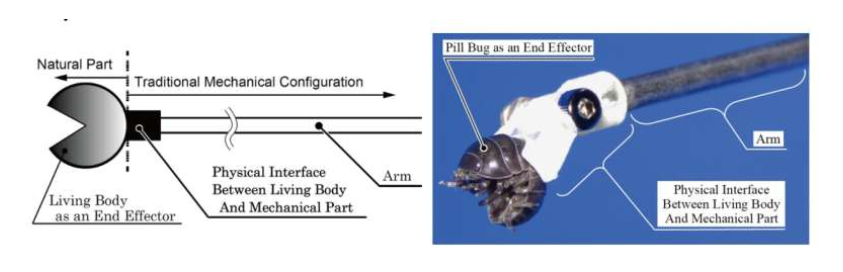 Graphical abstract. Source: arXiv (2023). DOI: 10.48550/arxiv.2306.03906
Marking the first time an entire organism has been used as a so-called end effector, the research team created a 7 mm-wide harness attached to a robotic arm that weighed 0.76 grams. Placed within the harness, the pill bug reportedly closed its shell upon contact with a small piece of cotton, grasping it for roughly two minutes in the lab before releasing it.
Further, the team sought to mimic this functionality for underwater tasks and thus built a similar device for chiton, which reportedly grasped an array of objects such as plastic, wood and cork items. The researchers noted that traditional end effectors featuring suction devices typically don’t grasp cork or wood.
The research is detailed in the article “Biological Organisms as End Effectors,” which appears in the journal arXiv.
To see the pill bug serve as a robotic end effector, watch the accompanying video that appears courtesy of Tadakuma Mechanisms Group, Robotics Society of Japan.