Carnegie Mellon prints seaweed-derived actuators
Marie Donlon | June 27, 2023Researchers from Carnegie Mellon University have developed seaweed-based biodegradable actuators for marine applications.
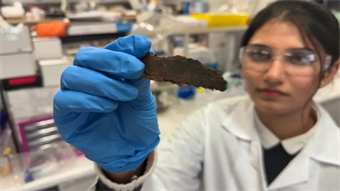
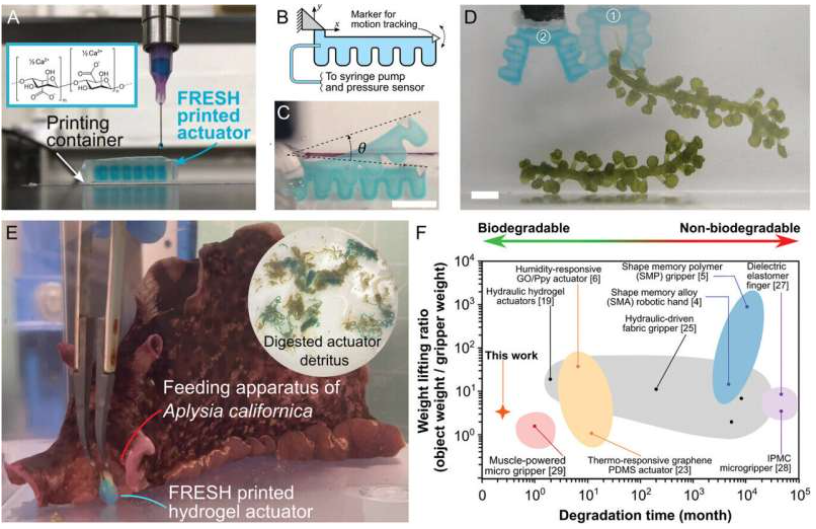
To develop the water-tight actuators, the team used a bio-ink derived from common brown seaweeds that rely on calcium to crosslink and create gels, and a 3D printing process developed by Carnegie Mellon researchers dubbed the Freeform Reversible Embedding of Suspended Hydrogels (FRESH) 3D bioprinting method, which allows for the printing of soft gels.
 Source: Carnegie Mellon
These seaweed actuators, according to their developers, can extend, bend, twist and can be combined to create structures for gripping and positioning.
Further, the fully degradable material will decompose in ocean water in just one week and can be safely consumed by marine organisms.
The seaweed-based actuators are being eyed by the researchers to replace the components typically used to create soft robots — such as synthetic polymers, rubbers and plastics — which do not degrade easily in the environment after their lifetimes.
An article detailing the seaweed-derived actuators, “Sustainable Hydrogel Actuators with Shape and Stiffness Morphing Capabilities via Embedded 3D Printing,” appears in the journal Advanced Functional Materials.