
Groundwater extraction shifts Earth’s axis
S. Himmelstein | June 23, 2023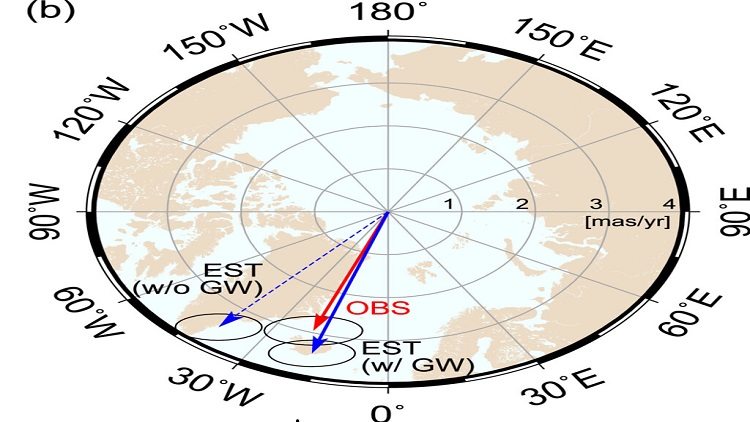 The observed polar motion (red arrow) is compared to the modeling results without (dashed blue arrow) and with (solid blue arrow) groundwater mass redistribution. The model with groundwater mass redistribution is a much better match for the observed polar motion, indicating the magnitude and direction of groundwater’s influence on Earth’s spin. Source: Seo et al. (2023), Geophysical Research Letters
The global implications of groundwater extraction extend beyond water resource supply concerns. Recent research indicates that such activity has tilted the Earth nearly 80 cm (31.5 inches) east between 1993 and 2010 alone.
The potential of water to alter the Earth’s rotation was discovered in 2016, prompting researchers from Seoul National University (South Korea), University of Melbourne (Australia), Kyungpook National University (South Korea), Hong Kong Polytechnic University (China) and University of Texas at Austin to model the observed changes in the drift of Earth’s rotational pole — the point around which the planet rotates — and the movement of water.
Previous research estimated humans pumped 2,150 gigatons of groundwater, equivalent to more than 6 mm (0.24 inches) of sea level rise, from 1993 to 2010. The analysis published in Geophysical Research Letters first considered only ice sheets and glaciers, and then addressed different scenarios of groundwater redistribution. The model only matched the observed polar drift once 2150 gigatons of groundwater redistribution was included. Without it, the model was off by 78.5 cm (31 inches), or 4.3 cm (1.7 inches) of drift per year.
Redistributing water from the midlatitudes exerts the greatest impact on the rotational pole. During the study period, the most water was redistributed in western North America and northwestern India, both at midlatitudes. The researchers maintain that attempts to slow groundwater depletion rates, especially in these sensitive regions, could theoretically alter the change in drift, but only if such conservation approaches are sustained for decades.



That seems like serious stuff. If the earth's axis is altered very much, then, it's orbit may change. A multitude of bad things can happen! It may be AMF!!
In reply to #1
I agree--serious stuff, but was the study peer-reviewed? 31.5" change? but where? Why not given in degrees of tilt? There are a couple of other things missing or misstated; I need to ask for more info.
In reply to #2
Yes, more definitive verifiable data must be presented. But the earth is a very fragile glob of mass. A little out of kilter here and there and AMF! The earth has had many changes in orbit, gravitational constant, magnetic flux density, and on and on. But none of the changes have been earth quencying. Since civilization has come on the scene about 10000 years ago, things have changed. We can now measure a lot of these earth threatning things. It's hard to distinguish what is real or just a bunch of number gyrations. It's hot now but it was also very hot when I was chopping and picking cotton in the Brazos bottom in 1950. Global warming is real and the ocean levels are rising and purchasing beachfront property in Arizona may not be a bad deal, afterall.
The picture is a bit misleading. The entire northern hemisphere is overlaid by a circle of radius 4 milliarcseconds. An arcsecond is about 101 feet, and 4 milliarcseconds is just short of 5 inches. I don't think we should panic.
Oh, dear! Something else to worry about!
Personally, I don't give a #^%@#.
Has anyone addressed the effect of dams on the rotation? I think dams would probably have more of an effect because of greater mass, even when not at the mid latitudes.
So many world damaging theories? When are we going to deal with the over population problem, this would diminish all the other troubles we seem to be having.