A tool to nurture smarter irrigation
S. Himmelstein | June 07, 2023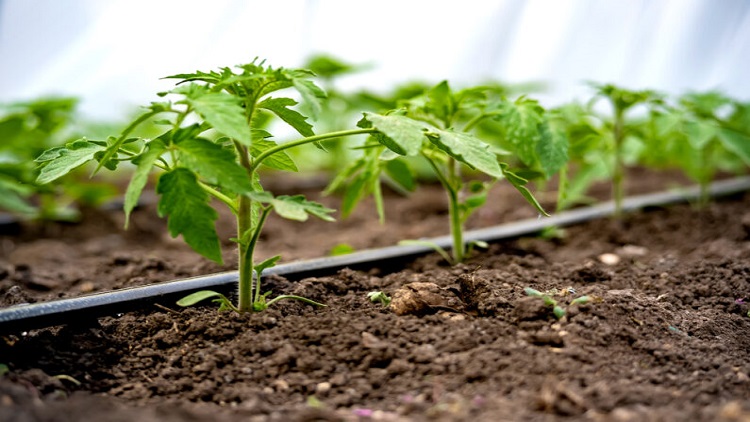 Smart systems for drip irrigation water crops when and where they need it most. Source: Getty Images
A faster route to the determination of agricultural evapotranspiration rates and for the optimization of irrigation schedules has been devised by Stanford University researchers. The highly accurate modeling scheme is claimed to be 100 times faster than available estimation methods.
The tool described in Water Resources Research is intended to make agriculture smarter by increasing the efficiency of water use. Accepted approaches for evapotranspiration accounting consider only the vertical flow of water applied during irrigation, ignoring the horizontal flow essential for examining the efficiency of drip irrigation systems. The new system analyzes all variations of spatial flow to provide more precise determinations of soil moisture, root water uptake and evapotranspiration.
The data generated by combined use of enhanced Kalman filter and maximum likelihood estimation algorithms will inform smarter agricultural practices by directing irrigation resources in real-time to where they are most needed.
When applied to a simulated plot of land measuring approximately 5 feet by 33 feet in width, the modeling system generated a precise estimate of the evapotranspiration rate in about 10 minutes. If an enhanced Kalman filter alone was used, as other recent studies have demonstrated, the computational time would have run on the order of 100 times longer, or about 1,000 minutes.
As a result, an irrigation optimization system based on the modeling tool could be responsive in near-real time to changing conditions.