A superconducting place for palladium
S. Himmelstein | May 11, 2023The development of superconducting materials has focused on the use of nickelates and cuprates, which retain their superconducting powers at specific critical temperatures. Many materials become superconducting only just above absolute zero (-273.15° C), while others retain their superconducting properties even at much higher temperatures. An international research effort has now pinpointed a material with a higher, more easily attainable critical temperature: palladium.
Advanced computer modeling indicates that swapping out nickel for palladium could deliver a material that superconducts at even higher temperatures than cuprate superconductors.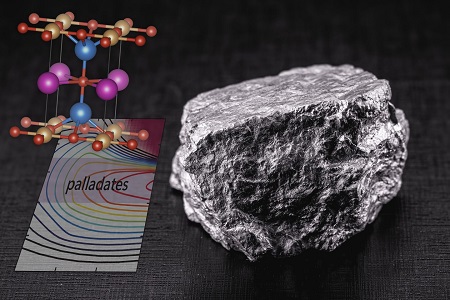 Palladium-based materials could be key to the attainment of superconductivity. Source: Vienna University of Technology
A standard condensed-matter-physics model — the single-band Hubbard model — was used to predict critical temperature for nickelates and to examine material performance while varying the electrons’ interaction strength, filling factor and energy-momentum dispersion. Documenting the strength of electron-electron pairing that leads to the emergence of superconductivity enabled determination of the electronic configuration that optimizes temperature conditions. While neither nickelates nor cuprates approach these optimized conditions, palladates were observed to more efficiently attain the desired conditions that maximize critical temperature.
[See also: Superconductors and their applications]
The research conducted by scientists from University of Hyogo (Japan), RIKEN Center for Emergent Matter Sciences (Japan), Northwest University (China), Vienna University of Technology (Austria), King’s College London (U.K.) and University of Tokyo (Japan) is published in Physical Review Letters.