De-icing solar panels
Marie Donlon | April 30, 2023Ice and snow accumulation on solar panels isn’t as dangerous as ice and snow accumulation on airplane wings or roadways, but it it’s a nuisance, nonetheless — one that inhibits solar output, which is the very function of solar panels.
Instinctively, a user might take a shovel or other such tool to solar panels in an attempt to clear solar panels at a residence, for instance, but experts advise against this as it may damage or, in extreme instances, destroy the power generating devices.
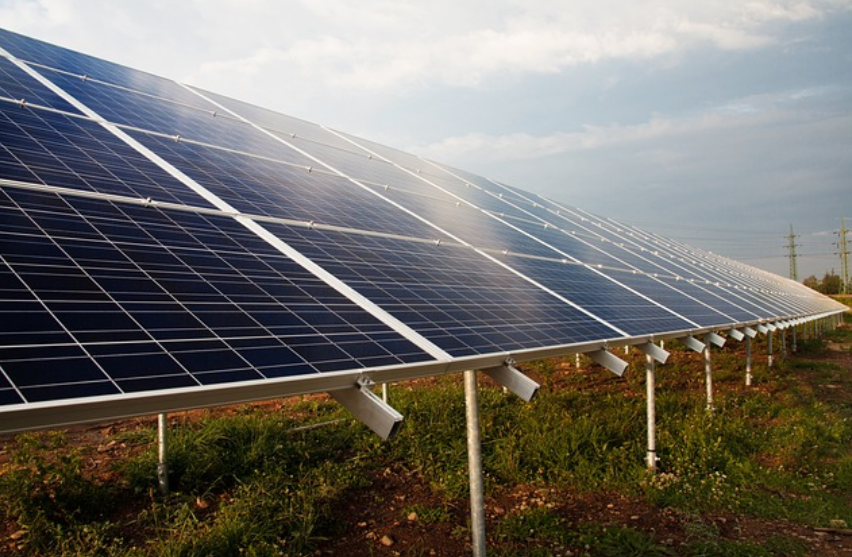
Eventually, snow and ice will melt, and solar output will improve as solar panels absorb the sun’s rays to generate electricity or heat as intended. But to hasten that along, researchers from all over the world are creating solutions that would help clear accumulation from solar panels. Follow along with GlobalSpec — as it recently did with airplane wings and roadways — to revisit some of these de-icing solutions.
Clear coating
A team from the University of Michigan has developed a new coating to improve the performance of solar panels in cold climates.
The clear coating, according to the researchers, is composed of polyvinyl chloride (PV) and polydimethylsiloxane (PDMS) plastic and silicone or vegetable-based oils.
Brushed or sprayed onto the solar panel, the clear coating reportedly reduced snow and ice accumulation on solar panels, thereby enabling them to generate roughly 85% more energy during testing. Additionally, the coating was determined to shed snow for up to a year.
To develop the coating, the researchers concentrated on two properties that have been the basis for previous ice-shedding coatings: low interfacial toughness and low adhesion strength. Low surface, otherwise known as slipperiness, means that the coating works on small areas, but the larger the surface, the more force is required to slide off snow and ice. As such, larger areas require breaking up the adhesion altogether. According to the researchers, low interfacial toughness accomplishes this, creating cracks between the ice and the panel that form along the panel, breaking the ice and snow free.
According to the study, the researchers employed a combination of low surface adhesion and low interfacial toughness to repel ice and snow from both small and large surfaces. They initially employed PVC plastic for low interfacial toughness and mixed in a small amount of vegetable oil to imbue the PVC with low enough surface adhesion. A second, equally successful solution was also devised using PDMS plastic and silicon-based oil.
Crack coating
Researchers from the Norwegian University of Science and Technology (NTNU) are working to prevent ice buildup on solar panels by cracking it.
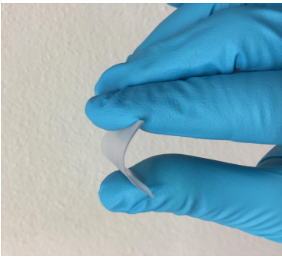 Source: NTNU Nanomechanical Lab
To keep ice from sticking to surfaces, researchers have tried manipulating physical forces to produce interface cracks at the nanoscale — otherwise known as the atomic scale and the micro scale.
Previous efforts focused on creating slippery surfaces that rely on surface chemistry to encourage cracks by weakening atomic bonds between the ice and surface. These surface-chemistry-related substances are called nano-crack initiators (NACI).
At the microscale, researchers created micro-bumps on surfaces they wanted to keep ice-free. The roughness of these micro-bumps, dubbed micro-crack initiators (MICI), promotes micro-cracks at the site of contact between the surface and the ice, where it limits the ability of ice to stick to the treated surface.
Because these mechanisms together aren’t exact at preventing ice from sticking, several commercial and homemade coatings that rely on NACI and MICI to reduce the sticking capability of ice to surfaces were also tested.
Eventually, the researchers determined that adding another structure below the surface could form macro-cracks at the site where the surface and the ice meet — a mechanism dubbed macro-crack initiator (MACI).
As the cracks grow, the ice is less likely to cling to the surface thanks to the MACI mechanism. To test this approach, the researchers produced subsurface layers featuring micro-holes or pillars along with a thin film of polydimethylsiloxane (PDMS), for covering the holes and the bumpy substructure layers.
Tests demonstrated that surfaces featuring the MACI substructures had ice adhesion strengths that were 50% weaker than the pure PDMS surfaces without MACI. In fact, surfaces with the MACI design reportedly demonstrated some of the lowest values for ice adhesion ever measured.
"The ice adhesion strength for common outdoor steel or aluminum surfaces is around 600-1000 kPa," the researchers said. "By introducing the novel MACI concept to the surface design, we reached the super-low ice adhesion value of 5.7 kPa."
Solar panel warmer
To keep solar panels free from snow and ice accumulation, energy startup NextStep Electric has developed its (Solar)PanelWarmer.
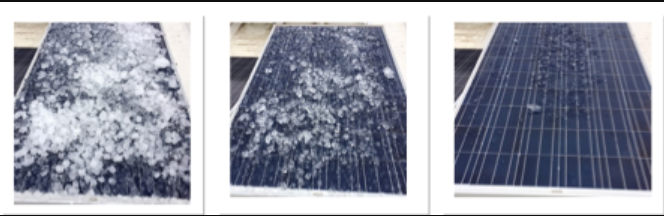 Source: NextStep Electric
The (Solar)PanelWarmer can be fit to any size solar panel and keeps solar systems active following snowstorms. The systemcan be operated manually or via a thermal trigger, and the company says that during tests, the technology achieved 5 lb of ice per foot melting in under three hours.
During operation, the panel warmer uses roughly 150 W/hr per panel at full capacity of 80° F.
Pulsed Joule heating
A team of scientists from the University of Illinois Urbana-Champaign created a coating material for removing snow and ice from solar modules via “pulsed Joule heating,” wherein the passage of current through an electrical conductor generates thermal energy. According to the team of scientists, pulsed Jjoule heating dramatically cuts energy consumption along with the time it takes to melt snow and ice.
To accomplish this, the team added a superhydrophobic (SHP) coating to module glass, depositing a nanoscale-thick aluminum (Al) layer on the cover glass, and then immersed it in hot deionized water to develop aluminum oxyhydroxide (AlO(OH)) nanostructures.
Following hydrothermal treatment, the film was optically transparent with a surface roughness lower than 30 nm, so as not to encourage visible light scattering.
“The combination of optical transparency and superhydrophobicity in the same coating allows for multi-functionality to enable pulsed Joule heating for desnowing and defrosting on PV panels,” the researchers said. “For desnowing of PV panels, the cover glass needs to be capable of efficient pulsed surface heating, superhydrophobicity, and optical transparency.”
Further, indium tin oxide (ITO) comprised a layer for the purpose of Joule heating, due to its optical transmittance of more than 85%, in addition to its electrical characteristics. The researchers suggest that the thin-film heater, which features a superhydrophobic surface, functions at the interface of the substrate and snow and ice where it achieved interfacial defrosting by restricting the heat to a thin region.
A series of tests indicated that this method of snow and ice removal from solar panels is three times faster than conventional methods. The technique requires just one single pulse of electrical current to heat the surface for completely removing snow and ice accumulations.
Solar-powered de-icing
A team of scientists from Massachusetts Institute of Technology has developed a passive de-icing system that relies exclusively on the power of the sun (or artificial light).
According to its developers, the system features a three-layered material that collects solar radiation, turns it into heat and spreads it across the surface to be de-iced.
Specifically, the top layer of the material captures sunlight and converts that solar radiation into heat. Further, the team added a 400 micrometers-thick layer of aluminum to function as the so-called spreader, thereby enabling the heat from the absorber layer to be laterally spread across the surface of the material, melting the layer where the ice and surface meet. Finally, the third layer consists of a foam insulation, which prevents the heat from escaping downward.
Check back with GlobalSpec for more on de-icing surface solutions…next winter.