Decarbonization of heavy equipment
Jody Dascalu | April 22, 2023Many governments around the world are seeking to deliver net zero emissions by the year 2050. The U.S. has joined this initiative with long-term strategies to attain net-zero greenhouse gas emissions by 2050. On the path to lower emissions, the decarbonization of heavy construction equipment rises to the challenge via robust carbon footprint accounting, and in tune fleet management services. Above all, an innovative mindset and being open to the changing landscape when it comes to environmentalism and technological advancement plays a key role in achieving ambitious emission targets across industry sectors.
Environmentalism in the limelight
This contemporary environmental movement is thought to have arisen primarily from concerns about the negative health consequences of pollution during the Industrial Revolution in the late 19th century. At this time, environmentalism became a significant social movement along with a growing culture of political activism. While the pandemic recently swept global headlines and changed the world, environmental concerns have been a steady constant in media outlets.
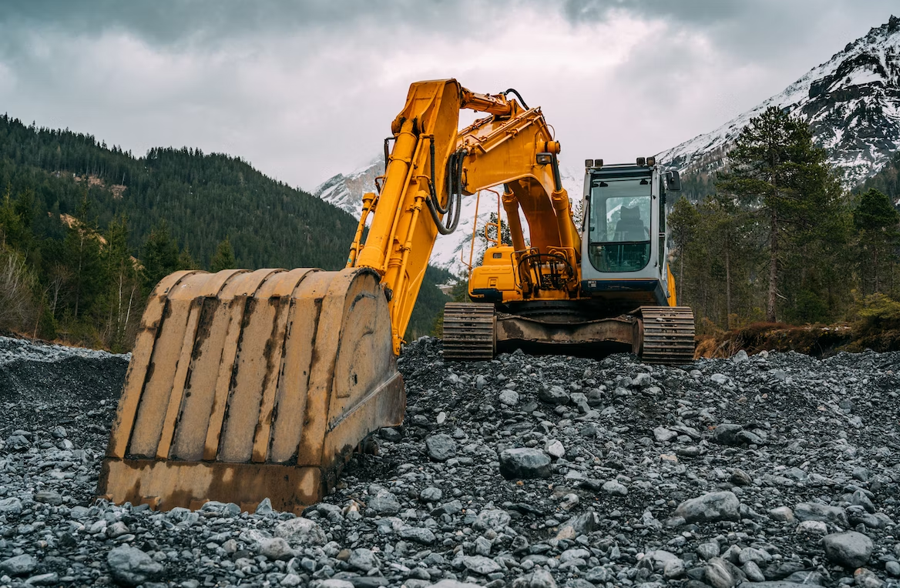 Excavator in mountain scenery. Source: Gerold Hinzen/Unsplash
While there are polarizing opinions about the effect of technological advancement on the environment, most organizations recognize the need to reduce undue waste. As the long-term effects of pollution are debated, it is clear that greater efficiency in business operations often leads to increased profits and increased productivity while reducing emissions.
Infrastructure design and emissions
The way that infrastructure and buildings are delivered will play a critical role in how countries around the world meet carbon-reduction targets. Much attention is placed on the design of cities and infrastructure to encourage reduced emissions but construction activities to create and build infrastructure also account for a significant portion of emissions.
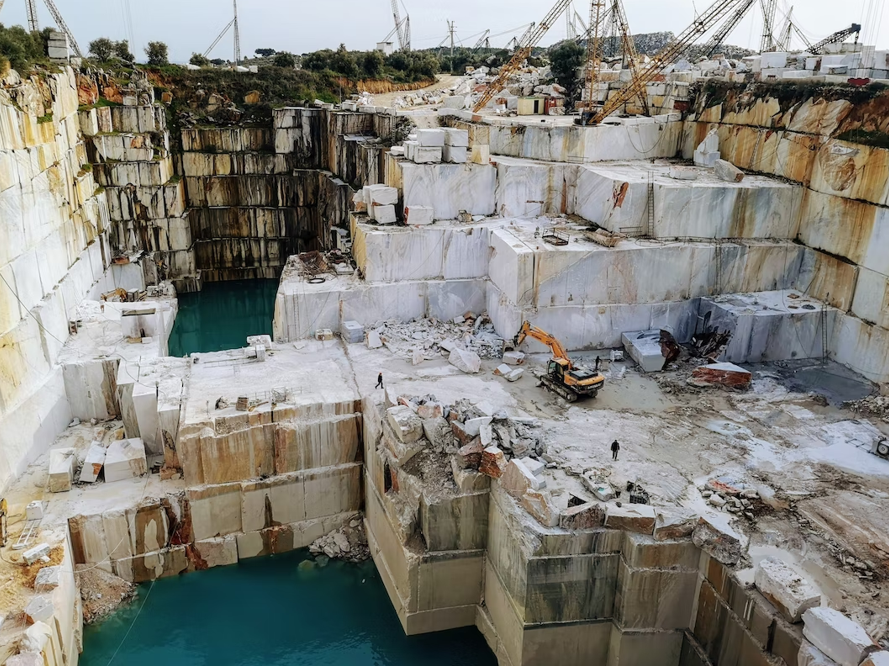 A quarry. Source: Mariana Proença/Unsplash
This area is an opportunity for the construction industry to help governments meet emission targets. The commitment to change is seen across the construction industry already with tangible goals and measures being taken toward sustainable practices.
For example, some construction machinery can be switched to electric power to decrease emissions. Some building materials can be recycled to help reduce waste. More sustainable materials such as low-carbon concrete can also reduce the carbon footprint of the construction industry.
A digital angle
Digitalization has helped increase efficiency across the construction sector. By increasing machinery uptime and improving working conditions, operational costs can be reduced. When operational efficiency is enhanced, carbon emissions are reduced as a result. In this industry, life cycle analysis and asset management are increasingly becoming the forefront of business decisions and considerations. Automation and digital technologies have advanced tremendously in the past couple of decades, so companies of varying sizes have access to business solutions that work for them. Telematics, the industrial internet of things, analytics and big data have impacted many aspects of the construction industry.
Uncertainty in economies worldwide has led to unstable financial situations for many earthmoving contractors, heavy plant suppliers and aggregate suppliers. As a result, it is now critical to reduce overall running costs. Reducing overall running costs reduces the overall fuel usage, which in turn decreases carbon emissions. Fuel consumption has always been a significant portion of overhead and accounts for a significant portion of a machine’s operating costs.
Lowering fuel usage can be achieved by monitoring idle time, hydraulic relief deterrence, using automatic shift and preventing overload of machinery. Heavy-duty mobile equipment spends a large portion of time idling on-site. One leading heavy equipment manufacturer has estimated that the average heavy machine will spend approximately 40% of its time idling while in operation. This percentage has also been estimated from 28% to 30% by other businesses. Idle reduction can be a huge fuel saving opportunity for heavy plant operators that can be achieved with digitalization.
Alternative fuel sources
A major roadblock preventing the development of zero-emissions construction equipment is that significant investments are needed in the research and development (R&D) of new machines. Current heavy equipment using combustion engines would need to be completely redesigned. As new models are produced, heavy equipment manufacturers are considering hybridization, fuel cells and hydrogen engines for all sizes of construction machines.
Resources in developing construction machines with alternative fuel sources are finite. As a result, research into the hydrogen fuel cell and battery electric equipment are competing for similar R&D resources.
Hydrogen is leading the way in the decarbonization of heavy equipment. Supporting technologies for hydrogen fuel cells also require significant investment such as hydrogen production, distribution, storage and filling. Hydrogen fuel cells will need adequate supply chains for their production and maintenance. To date, these supply chains have not been fully developed worldwide.
Green energy such as wind, solar and geothermal and the storage of electrical energy also need to be considered for battery-powered equipment. Simply using electric vehicles may reduce net emissions but the opportunity to use green energy exists to further drive sustainability. However, full life cycle assessments of the true impact of these technologies on the environment in these scenarios must be analyzed as manufacturing green technologies often requires nonrenewable resources and produces waste.
Likely one of the major roadblocks to green heavy equipment is that the total cost of ownership must be lower than diesel and gas machines or near equal for industry adoption. Some governments, organizations and activists propose that this can be achieved by increasing taxes on machines using internal combustion engines (ICE) and increasing taxes on those fuel sources. This could have detrimental implications for the profitability of the construction industry.
The current reality is that zero-emission heavy equipment does not have the same performance as diesel ICE machines. Battery electric vehicles have high battery costs and long charging times, and they need to be recharged regularly. Hydrogen engine vehicles need large hydrogen tanks to achieve the required operating times in the construction industry. Fuel cell electric vehicles also have high component costs and need large tanks to achieve the desired operating times.
Incremental change
It is critical to realize current roadblocks to reducing the emissions of heavy equipment so that those problems can be addressed before action is taken. Overall, incremental changes to the construction sector can help the industry reduce emissions. As alternative fuel technologies are further researched there are steps that can be taken in the meantime to increase efficiency.
About the author
Jody Dascalu is a freelance writer in the technology and engineering niche. After earning a Bachelor of Engineering, she worked in the manufacturing industry as an analyst. As an avid reader, she enjoys researching upcoming technologies and is an expert on a variety of topics.