Tribology testing tech for electric vehicles
S. Himmelstein | April 10, 2023Fluid testing tools have not kept pace with the electrification of the automotive industry, driving U.S. Southwest Research Institute researchers to devise a new test apparatus to model the effects of electrification on rotating parts. A commercial tribology testing device has been modified to support evaluation of the impact of electric currents in fluids by measuring the wear and friction on automobile parts in the presence of an applied voltage.
Tribology testing specific to electric vehicles (EVs) is essential as the speed of the DC-to-AC frequency conversion in these systems can cause local voltage spikes that require grounding. Motor bearings are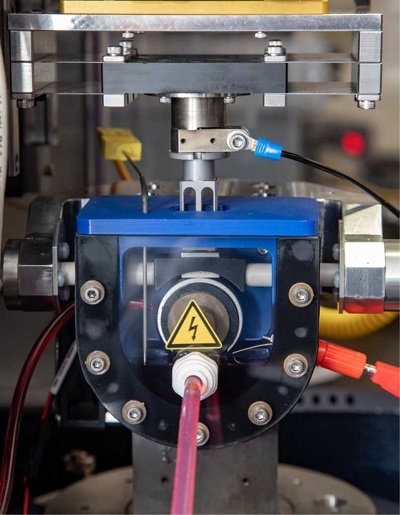 A commercial tribology testing machine was modified to more effectively analyze the friction and wear associated with lubricants formulated for EVs. Source: U.S. Southwest Research Institute often susceptible to electric currents flowing through them due to their location near the voltage spikes. The electric potential for the bearings can build until the voltage becomes strong enough to break down the thin film of lubricant separating the small metal ball bearings from the bearing raceways or bearing shells, which can cause surface damage and scarring.
A new test protocol and the small-scale bench setup designed around a traditional universal testing machine were used to examine different commercial lubricants and to measure wear scarring and friction on the bearing raceways and bearing shells. Results confirmed the fluid-dependency of lubricant breakdown and showed that electric potential across a fluid, whether the current is AC or DC, can affect wear and bearings friction by as much as 20%.
These bench-scale testing capabilities are expected to advance lubricant optimization for specific EV drivetrains and extend vehicle range as a result of reduced friction.