How rooftop solar saves water
S. Himmelstein | March 13, 2023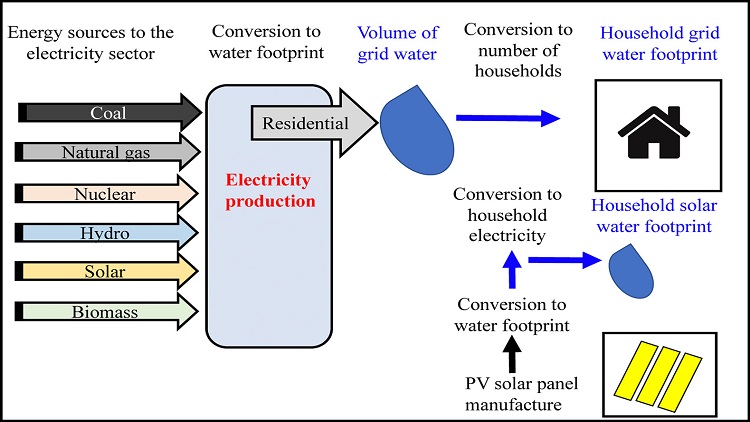 The installation of rooftop solar photovoltaics reduces the water footprint of grid electricity. Source: Duke University
It’s generally accepted that solar energy technology can cut carbon emissions and provide a sustainable power generation alternative to fossil fuel-based systems. An additional benefit is touted by Duke University researchers: the conservation of water resources associated with rooftop solar installations.
The consumption of water to manufacture and maintain conventional power system components, and to extract and process fossil fuels is not a factor in the rooftop solar ecosystem. The researchers acknowledge that the solar cell manufacturing cycle may incur environmental damage in the form of heavy metal release. However, this cycle entails a one-time consumption of a lower volume of water and is followed by zero water use during the lifetime of the cell.
The research published in Science of The Total Environment combined energy sources that are used to generate grid-based electricity for the residential sector across the contiguous U.S. and translated that to the volume of water consumption in each state. Calculations estimate that the total amount of water consumed for powering the residential sector across the U.S. is 2.6 trillion gallons.
The adoption of rooftop solar in the residential sector reduces the use of the grid electricity and therefore also the volume of water. In some states, like in the southwestern U.S., the individual household water savings can reach up to 1,000% percent upon installing rooftop solar. A given household may save an average 16,200 gallons of water per year.
Photovoltaic solar cells account for about 1.5% of electrical supply in the U.S., representing a savings of 99 billion gallons of water a year — equivalent to about four days of California’s total water usage.