Queuing Model Could Cut Runway Congestion, Save Fuel
Engineering360 News Desk | January 18, 2016Engineers at the Massachusetts Institute of Technology (MIT) have developed a queuing model that may help air traffic controllers direct airline departures more efficiently, minimizing runway congestion and saving fuel.
The model predicts how long a plane will wait before takeoff, given weather conditions, runway traffic and incoming and outgoing flight schedules. In tests at U.S. airports, the model encouraged controllers to hold flights during certain times of day, leading to significant fuel savings.
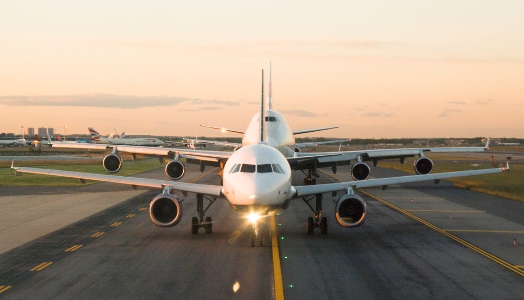 The nation’s aviation system is expected to experience widespread congestion in the coming years. Image credit: Morguefile.“In our field tests, we showed that there were some periods of time when you could decrease your taxi time by 20% by holding aircraft back,” says Hamsa Balakrishnan, associate professor of aeronautics and astronautics and engineering systems. “Each gate-held aircraft saves 16 to 20 gallons of fuel, because it’s not idling. And that adds up.”
To prevent extended runway queues, Balakrishnan and former graduate student Ioannis Simaiakis developed a model to predict taxiing time. The model consists of two modules; the first calculates a plane’s travel time from the gate to the departure runway, taking into account any interactions with other arriving and departing flights. For instance, a plane headed toward a clear runway may have to cross an active segment, causing a delay. The second module estimates an individual runway’s queuing delay—the time it takes for a plane to depart after joining the queue for takeoff.
The model factors in a number of inputs, including visibility conditions, pushback times of departing flights and runway configuration, and determines outputs such as the number of takeoffs every 15 minutes, the total number of aircraft taxiing out, the number of aircraft waiting in line for takeoff and how long an aircraft will likely have to wait before takeoff.
Balakrishnan and Simaiakis tested the model using data from the U.S. Federal Aviation Administration’s Aviation System Performance Metrics database, which contains pushback and takeoff times for every flight departing from 77 major U.S. airports. The database also includes runway configurations and local weather conditions at each airport.
The team used 2011 data on departure operations at Newark Liberty International Airport to train the model and then used it to predict airport congestion and the length of takeoff queues, using pushback times from 2007 and 2010. The researchers found that the model’s results matched actual data from both years, predicting the length of queues, plus or minus two aircraft.
Balakrishnan says the queuing model gives air traffic controllers accurate predictions of what airport congestion would look like if they took certain actions, such as continuously pushing planes back from the gate. Controllers can then use these predictions to adjust their pushback times to avoid runway backup.
In addition to Newark Liberty, the team tested the queuing model at Boston’s Logan International Airport, LaGuardia Airport in New York, Charlotte Douglas International Airport in North Carolina and Philadelphia’s airport. Results suggest that the model may be easily implemented in departure procedures—a useful objective, as the nation’s aviation system is expected to experience widespread congestion in the coming years.