This spray-on smart skin uses AI to understand hand tasks
Marie Donlon | January 12, 2023Stanford University researchers have developed a spray-on smart skin that promises to bring people one step closer to the possibility of invisible keyboards, identifying objects exclusively by touch and communicating via hand gestures in immersive environments.
The new stretchable biocompatible material can reportedly be sprayed on the skin — on the back of a hand for instance — and features an electrical network that senses when the skin is stretched or bent. Using artificial intelligence (AI), researchers suggest that they can interpret daily tasks as carried out by hand motions and gestures.
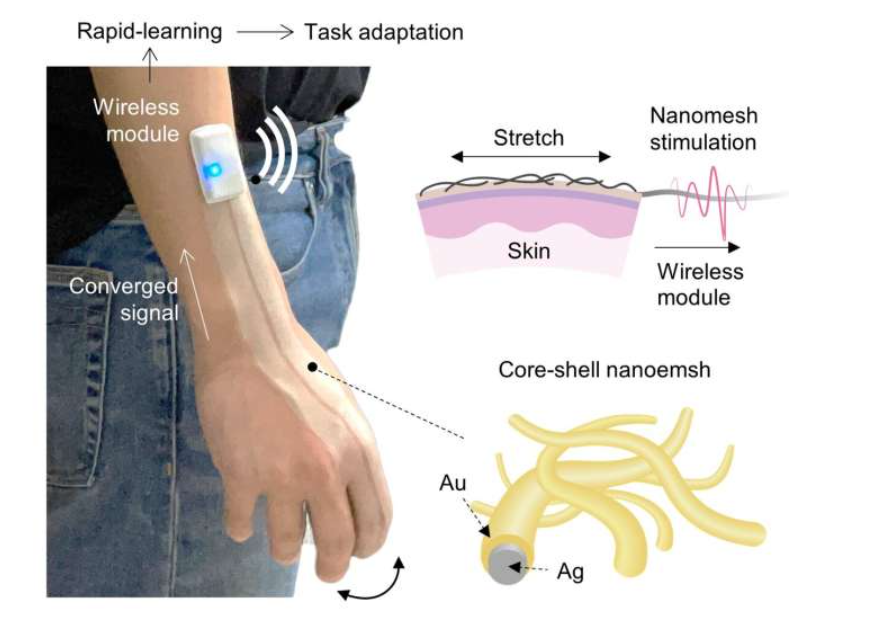 Spray-on sensory system which consists of printed, bio-compatible nanomesh directly connected with wireless Bluetooth module and further trained through meta-learning. Source: Kyun Kyu “Richard” Kim, Bao Group, Stanford University
With possible applications for gaming, sports, robotics and tele-medicine, the sprayable skin features an electrically sensitive mesh network composed of millions of nanowires of silver coated with gold embedded in polyurethane. These nanowires, according to the researchers, are in contact with each other, thereby forming dynamic electrical pathways.
The developers of the spray-on skin suggest that the mesh is electrically active, breathable, biocompatible and will stay on the skin unless washed away with soap and water. Further, a lightweight Bluetooth module can reportedly be attached to the mesh, wirelessly transferring the signal changes.
"As the fingers bend and twist, the nanowires in the mesh get squeezed together and stretched apart, changing the electrical conductivity of the mesh. These changes can be measured and analyzed to tell us precisely how a hand or a finger or a joint is moving," explained the researchers.
At this point, machine learning is employed wherein computers are used to monitor the shifting patterns in conductivity and map those changes to distinct physical tasks and gestures. For instance, if an X is typed on a keyboard, the algorithm reportedly learns to recognize that motion according to the shifting patterns in the electrical conductivity. The researchers suggest the when the algorithm is trained, a physical keyboard would no longer be necessary.
An article detailing the spray-on skin, A substrate-less nanomesh receptor with meta-learning for rapid hand task recognition, appears in the journal Nature Electronics.
More information on the spray-on skin is also available in the accompanying video that appears courtesy of Stanford University.