A data hub for battery innovation
S. Himmelstein | February 06, 2023The model of innovation exemplified by the Human Genome Project, which generated the first sequence of the human genome by mapping DNA sequences, is being extended to battery technology to increase data generation flexible sharing to accelerate the development of new energy storage solutions.
An international group of researchers is participating in the Battery Data Genome project, focusing on the formation of an extensive database network to enable energy storage breakthroughs using artificial intelligence (AI). The initiative will collect and house data from every step of the battery lifecycle, from discovery to development to manufacturing and all manner of deployments. Having universal standards for data management for each segment of the battery community is required for data creation to unlock the power of AI algorithms designed to identify everything from new candidate electrode materials to improved battery pack construction to cell lifetimes.
Building a repository of consistent and accessible data requires that companies work together to format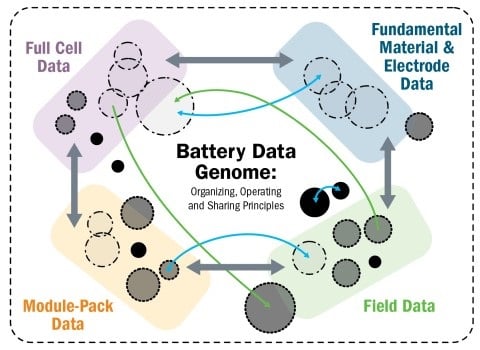 Visual representation of the Battery Data Genome illustrates how data flows freely between data hubs, even though not all hubs are entirely open. Source: U.S. National Renewable Energy Laboratory information in a specific way with uniform standards for metadata, which identify how the data are collected. Although these standards do not currently exist, enhanced collaboration through the Battery Data Genome is necessary to improve the accessibility and sharing of crucial data.
To attract as many partners as possible, the researchers acknowledge the importance of many options for data sharing. Not all data included within this project needs to be shared openly for success, and only some sharing routes will be fully open. Even project teams unable to contribute their data, such as industry partners, are invited to join the Battery Data Genome and take advantage of data shared by academic or government partners.
Open software for clean-up of existing data files is available as a battery-data-toolkit, and a paper outlining the goals and principles of the project is published in Joule.
Researchers from U.S. Argonne National Laboratory, U.S. Idaho National Laboratory, Carnegie Mellon University, University of Oxford (U.K.), University of Washington, Toyota Research Institute (California), SINTEF Industry (Norway), U.S. Sandia National Laboratory, RWTH Aachen University (Germany), University of Hawaii and U.S. National Renewable Energy Laboratory are currently involved in the Battery Data Genome project.