Startup Aims to Commercialize Biomass Gasifiers
January 11, 2016Tapping into the growing interest in distributed generation, Berkeley, California-based All Power Labs (APL) says it is commercializing a personal waste-to-energy appliance that it says can generate on-demand power for one-quarter the operating cost of diesel and half the capital expenditure of solar.
The technology behind the company's Power Pallet relies on biomass gasification principles first demonstrated 200 years ago: incomplete, or choked, combustion can be used to transform solid organic materials and other carbonaceous solids into usable power. Solid fuels like wood are heated without enough air to complete the combustion process, meaning that the output gas still has combustive potential. The unburned gas is then piped away to burn elsewhere.
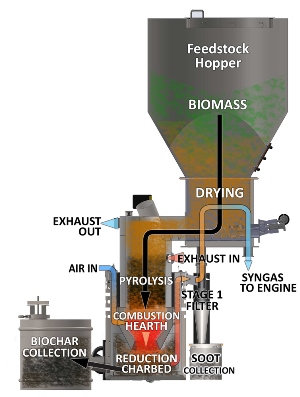 Schematic of the biomass gasification process. Image credit: All Power Labs. Gas produced by this method goes by a variety of names, including “town gas” and “wood gas." The Power Pallet's outputs are AC electricity and heat. The unit has a continuous power rating of 15 kW at 50 Hz or 18 kW at 60 Hz and consumes 1.2 kg/kWh, the company says. With a retail price of $25,000, the cost is about $1.40 per watt.
Approved and tested input materials include hardwood and softwood chips, walnut shells, corn cobs and coconut and palm kernel shells. (Coal, tires, plastic and municipal solid waste are not approved and void the unit's warranty, the company says.) The company says it has sold/installed units in countries including Haiti, Liberia and the Philippines, where biomass materials are prevalent.
While the 800 kg Power Pallet is designed to be compact and portable, the company is working to develop a 150kW biomass power generation system enclosed within a standard 20-foot shipping container. The goal is a total system-in-a box—biomass hopper, gasifier, gas filter, engine, generator and electrical output control—with no on-site construction required.
The Powertainer was originally developed as part of a U.S. Department of Energy project with the University of Minnesota, Morris; Cummins Power; and the Diesel Research Lab of the University of Minnesota, Twin Cities. In January 2015, APL received a $2 million grant from the California Energy Commission to begin work to commercialize the technology.
Along with project partners the University of California, Berkeley, Sierra Pacific Industries and the Placer County Air Pollution Control District, APL will work to make the Powertainer a modular power plant able to convert forest fire waste into energy.