
Scrubbers as a major source of Baltic Sea pollution
S. Himmelstein | December 30, 2022Scrubbers used on ships to clean exhaust gases and reduce air pollutant emissions have been identified as a major contributor of contaminants to waters in the Baltic Sea. Seawater is used to wash exhaust gases from the scrubbers, releasing hazardous substances to the marine environment.
Researchers from Chalmers University of Technology (Sweden), the Swedish Environmental Research Institute and the Finnish Meteorological Institute confirm that water discharged from exhaust gas treatment systems is responsible for up to 9% of certain emissions of carcinogenic and other hazardous substances in the Baltic Sea. According to data published in the Marine Pollution Bulletin, more than 200 million m3 of environmentally hazardous scrubber water were discharged from ships that used exhaust gas cleaning systems in the Baltic Sea in just one year.
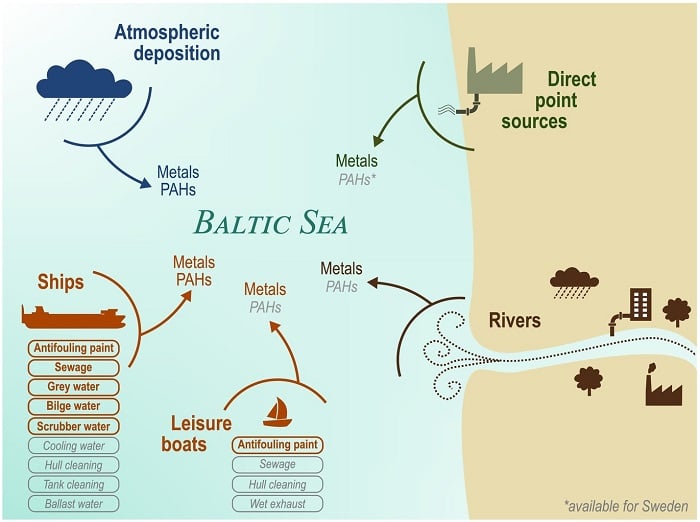 Direct discharges and atmospheric deposition of metals and PAHs to the Baltic Sea. Grey text in italic indicates substances and sources where data is lacking and thus not included. Source: Erik Ytreberg et al.
Scrubber wash water contributes up to 9% of the emissions of certain cancer-causing polycyclic aromatic hydrocarbons (PAHs) into this marine ecosystem, and vessels painted with copper-based antifouling paints account for a third of the total copper load. The use of open loop scrubbers on ships was identified as a major source of vanadium and anthracene to the Baltic Sea. Switching to closed loop mode could reduce the loads of most PAHs and metals with up to 90%.
The results of the study commissioned by the Swedish Transport Agency and the Swedish Agency for Marine and Water Management has spurred these bodies to propose a ban on the discharge of scrubber water into the internal waters of the Baltic Sea.


