Tracing lithium back to its source to ensure ethical mining activities
Marie Donlon | August 19, 2022A consortium of French researchers — including members from BRGM, Orléans, EDF, EDF R&D, 77818, Moret sur Loing and Université Grenoble-Alpes — suggests that commercial lithium can be traced back to the source it was mined from, making lithium sourcing a potential reality amid reports of unethical behaviors in the mining industry.
Lithium, used in the manufacture of everything from smartphones to automobiles, can potentially be traced back to its mine of origin using lithium isotopic signatures. This, according to researchers, could reveal whether or not lithium was mined from sources with a reported history of mistreatment of miners, destruction of local ecosystems and overuse of freshwater, among other unethical behaviors.
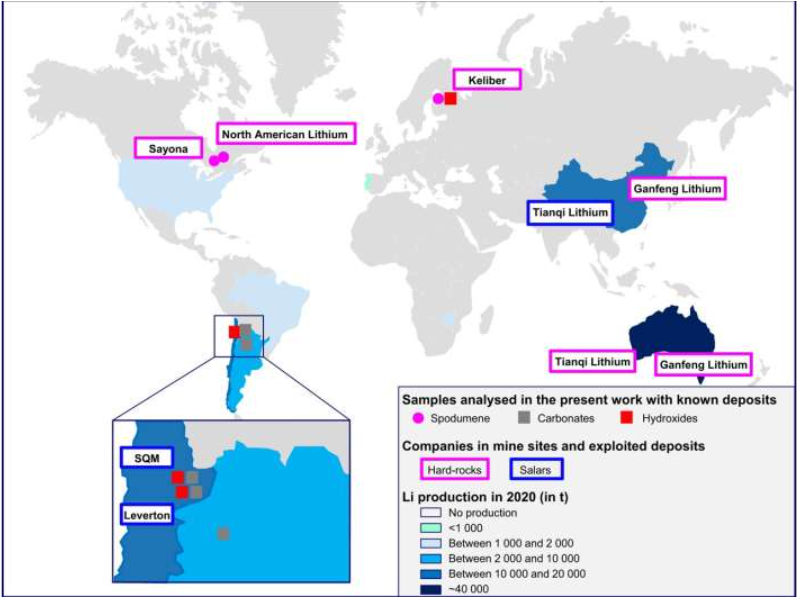 Source: Nature Communications (2022). DOI: 10.1038/s41467-022-31850-y
While calls to boycott such mines have been made from various sources, the researchers discovered that there is no real way to determine the origin of lithium. As such, researchers proposed that lithium from different mines would likely have different isotope ratios that can be used as unique identifiers, thereby making them traceable.
To further this determination, the researchers revealed that lithium has two stable isotopes — lithium-6 and lithium-7 — and the ratios of the two in a lithium sample vary from site to site due to differing environmental conditions.
Based on this discovery, the researchers suggest that the ratios could possibly be different enough to rely on as source signatures, especially if lithium samples are taken directly from all existing lithium mines to determine their ratios.
The research, Tracing the origin of lithium in Li-ion batteries using lithium isotopes, appears in the journal Nature Communications.