Jakarta Plans Wall to Hold Back the Sea
Engineering360 News Desk | December 29, 2015Jakarta, Indonesia, has begun construction work on the first phase of a decades-long $40 billion engineering project designed to protect the city from flooding.
The National Capital Integrated Coastal Development (NCICD) program is to be carried out in several phases, with the first stage involving fortification of the existing sea wall, construction of 17 artificial islands in the Bay of Jakarta and several water treatment projects. Latter stages envision the construction of a 32-km-long dike beyond the current sea wall that may include a harbor, highway, residential and industrial areas, water reservoir, waste treatment facilities, an airport, port facilities and green areas.
The design when viewed from the air, is intended to resemble a Garuda, the mythical bird that is Indonesia's national symbol.
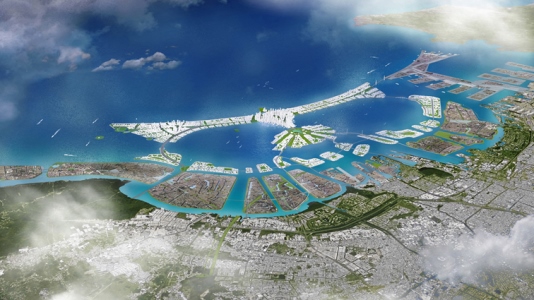 The sea wall design is intended to resemble a Garuda. Image credit: Witteveen + Bos.In September 2015, Indonesia, the Netherlands and South Korea signed a letter of intent for a feasibility study of the NCICD. The study, due for completion in March 2016, will focus on the start of later project phases.
The city of 10 million faces several challenges that the project intends to address. The metropolitan area sits in a low-lying basin, approximately 40% of which is below sea level. Moreover, it is sinking—up to 14 centimeters per year depending on location. This is believed to be the result of the extraction of ground water combined with pressure from high-rise buildings.
Jakarta is crossed by rivers that flood during the rainy season. The flooding and general poor water quality of the rivers can be breeding grounds for disease.
Reinforcing and raising the current sea wall is estimated to provide sufficient protection against storms and flooding from the sea for the next decade. Construction of the first portion of the outer sea wall is tentatively scheduled to begin in 2018 and is expected to take seven years.
To be constructed largely of sand—and with the potential for support by caissons—the outer sea wall will be designed to withstand a 1-in-10,000-year sea event, according to the NCICD. The maximum water depth in which it will be constructed is 16 meters, and the wall is intended to extend 7.7 meters above sea level. The base of the sea wall will be 380 meters wide at its deepest point.
In addition to providing a buffer from the ocean, the sea wall will close off the existing Bay of Jakarta, turning it from open salt water into a river-fed fresh-water reservoir. Given the state of Jakarta's rivers, opponents of the plan contend that the 7,500+-hectare reservoir could become polluted. A water treatment system is to be implemented, but specifics have not yet been finalized.
According to the NCICD, keeping the water level in the retention lake within its 2.5-meter fluctuation limits will require some of the largest pumps in the world, with a total pumping capacity of approximately 730m3 per second.
The Afsluitdijk in the Netherlands and the Saemangeum Sea Wall in South Korea both combine a sea wall with retention lake and most closely resemble the Jakarta plan in size.