Bio-Based Building Materials: Low Carbon and Energy-Efficient
Engineering360 News Desk | December 22, 2015A consortium of European companies and research institutions is developing bio-based aggregates that can used as energy-efficient, low-carbon alternatives to mineral-based building materials.
The ISOBIO project, funded under the European Commission's Horizon 2020 program, is intended to develop and demonstrate the effectiveness of using straw, clay, wheat, grasses and other organic materials in wall panels and renders.
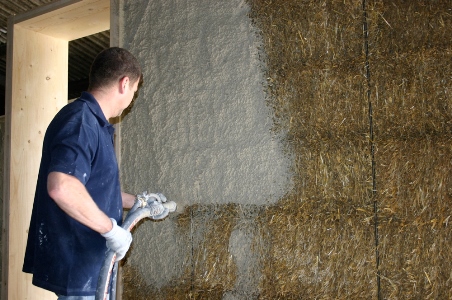 Straw, clay, wheat and grasses are used in wall panels and renders. Image credit: ISOBIO.According to ISOBIO, bio-based construction materials are capable of achieving a 50% reduction in embodied energy and CO2 emissions at the component level, with 20% better insulative properties compared to conventional materials. The group says that these expected improvements will lead to 15% lower construction costs and a 5% reduction in the total energy spent over the lifetime of a building.
The consortium began by identifying promising organic materials that could be used as insulation. Many of these are classified as waste or by-products of processes like food production. Finely chopped bio-materials such as hemp and straw are being treated with hygrothermal resins and nanoparticle gels to make them robust, breathable, moisture resistant and fire retardant.
The bio-aggregates under development are typically the result of combining both organic and inorganic materials. The organic material might have natural insulating properties, for example, while the inorganic material might make the resulting bio-aggregate more robust.
Combining organic materials with inorganic materials has proved challenging in some instances. Hemp, for example, is being combined with lime mortar—but the two materials have a degree of chemical incompatibility that can result in a reduction in the strength of the composite material. To overcome this problem, ISOBIO’s researchers are using nano-technology to increase the interfacial strength between the two materials, giving the resulting composite material improved mechanical and structural properties.
To make the hemp-based bio-aggregate water repellent, ISOBIO’s researchers are applying hydrophobic treatments to it. The result is that water vapor can travel in and out of the material, but liquid water cannot penetrate it.
According to ISOBIO, the experimental materials are demonstrating not only improved performance over conventional products, in some cases they are also yielding useful new properties. Hemp shiv, which is the core of the hemp stalk, for example, has a porous structure that provides moisture buffering to maintain humidity at a more constant level.
The project runs through the end of 2018, with field trials and demonstrations to be undertaken at partner sites to complete the proof of concept and test the scalability of the products developed.