Method Cleans Mine Water in Hours, Not Months
By Engineering360 News Desk | December 21, 2015A University of Florida chemical engineer has developed a water purification method that could reduce the time required to clean up phosphate mining operations.
Phosphate mines use water for mineral processing, dust suppression and slurry transport. The water, once used, holds particles of mineral byproducts, and typically is pumped into settling ponds where the particles sink to the bottom.
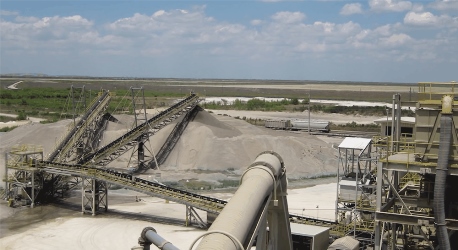 Cleaning the water left from mining operations can take up to 50 years. Image credit: University of Florida.Because the particles are electrically charged, their "like" charge causes them to repel each other. This keeps them suspended in the water instead of sticking together and sinking.
That means mining companies can re-use only water that has been skimmed off the top. Not only is the particle-filled water all but useless, but the land the settling ponds occupy could be used for other purposes.
Mark Orazem, professor of chemical engineering, has developed a system that allows a continuous feed of clay effluent into a separation system. There, upper and lower plates are used as electrodes. An electrical potential difference is applied across the electrodes. This creates an electric field, which causes the charged particles to move toward the bottom where they form a wet solid called a cake. In the cake dewatering zone, the particles can’t move and the water is forced to the top.
The cake may be used to fill the holes created by the mining operation. The water, meanwhile, becomes clear enough to be reused in the mining operation.
“Instead of having the water tied up in these clay settling areas, water is sent back through the process and then reused,” Orazem says.
Orazem’s team has created a lab-sized prototype. The next step, he said, is to determine how to scale it to a point where it can work in a real-world mine.
While Orazem’s concept was designed for Florida phosphate mines, he says it could be used anywhere and could be useful in North Africa. Morocco and the Western Sahara hold up to 85% of the world’s phosphate reserves, but water is in short supply.
“Recycling water is going to be critically important,” Orazem says. “In Florida, it’s an issue. In the desert, it’s going to be a major issue.”