Harnessing microbes for renewable energy
Jody Dascalu | April 25, 2022 Filtration pond. Source: Ivan Bandura/Unsplash
Microbes are everywhere. From the Earth’s soil to the air, the oceans and even the human body, microbes play a critical role in maintaining the balance of life.
As the world continues to consume more energy, it becomes increasingly difficult to sustain the current pace of human development, that is if humanity's energy needs continue to be fulfilled by fossil fuels. Engineers recognize the need for a better way to generate energy, and harnessing microbes to create renewable energy may be a viable solution.
People are in the midst of a global energy crisis, with oil prices rising at an increasing rate. With fossil fuels becoming increasingly scarce, and with the world’s population expected to reach 9.7 billion by 2050, harnessing renewable energy is fast becoming a necessity. Microbes are already used in a wide variety of industries, and if their power can be harnessed to create energy, then dependence on fossil fuels can likely be reduced.
Biofuels as an alternative to fossil fuels
Microbes have been harnessed for energy production for a long time, and recent advances in technology have made it easier to do so. Biofuels are an alternative to fossil fuels, and incur a lower environmental impact than traditional fossil fuels. They are also a renewable source of energy. In the past, inexpensive gasoline and diesel dominated the energy market and kept biofuels an economically unfeasible option for consumers.
Biofuels are one of the fastest growing sectors in the energy industry and its market share is expected to increase by 41 billion liters (28%) by 2026. They are becoming increasingly popular because they produce fewer emissions than gasoline and can be produced from a variety of sources. They are also completely biodegradable.
Biofuel production
Microbial biotechnology can be used to create biofuels by applying microorganisms to convert carbohydrates, lignins and glycerols into ethanol and biodiesel. As well, microbes can be used to create n-butanol, a carbon-neutral fuel, from only three ingredients: carbon dioxide, solar energy and light.
Biofuels can be produced in a variety of ways; chemical reactions and fermentations commonly drive biofuel production. Using farmland to produce biofuels presents other challenges, and it raises issues with using food to produce fuel; biofuels derived from waste have not been able to compete on price.
The conversion of biomass to biofuels is a large-scale industrial process that uses enzymes to catalyze the conversion of organic matter. The most popular biofuel, ethanol, is synthesized by fermenting sugars from sugar cane and corn. In the U.S., automotive gasoline is blended with 10% ethanol to increase the amount of oxygen and reduce emissions and increase fuel efficiency. However, most of the ethanol produced is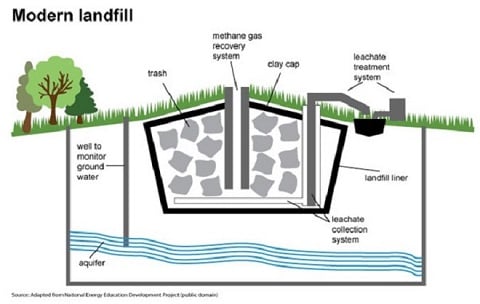 Modern landfill methane gas recovery schematic. based on fermentation of sugar from corn, though using other plant waste may be a competitive option in the future.
A renewable form of natural gas called biomethane or biogas can be used in heat and electricity generation as well as for transportation. This gas can be collected from landfills, wastewater facilities, farming and other sources. Agronomic and industrial waste accumulate in landfills and lead to environmental issues. Using this waste to create biofuels can reduce the environmental impact of fuel production and decrease greenhouse gas emissions.
Landfills often collect gas produced by decomposition and purify it further to produce biogas. Carbon dioxide, water vapor, hydrogen sulfide and other elements must be removed to make it a suitable substitute for natural gas.
 Anaerobic digester for livestock operations. Source: Vortexrealm/CC BY 3.0
Anaerobic bacteria live without the presence of oxygen, and break down biomass to yield biomethane. These bacteria are naturally present in soil, swamps or bogs, and in the digestive tract of animals and humans alike. Biomethane can be captured from solid waste landfills and manure storage ponds.
Anaerobic digesters can also be used to create and collect biomethane. When anaerobic decomposition is complete, the resulting biomass can be used as nutrient-rich fertilizers.
Bioelectrical cells create valuable chemicals in wastewater treatment
Bioelectrochemical systems (BECs) are also considered as promising solutions to current energy and environmental challenges. Microbial fuel cells (MFCs) and microbial electrolysis cells (MECs) are both BECs used to produce electricity from organic matter in wastewater, and in recent years, research has focused on creating systems that can be widely implemented.
Fuel cells have two electrodes -- an anode and a cathode -- which are connected with a wire to create an electric circuit. In an MFC, anaerobic bacteria break down organic matter at the anode. This process releases electrons, positively charged hydrogen ions and carbon dioxide. The anode collects the electrons which travel to the cathode, while the protons, or cations, travel through the solution to the cathode. The released carbon dioxide can be reused.
 Microbial fuel cell schematic. Source: Jody Dascalu
While MFCs are designed to produce electricity, MECs are designed to generate chemicals such as hydrogen or methane from organic material. MFCs are simply modified MECs, but instead small amounts of electricity are used to fuel the creation of more valuable chemicals.
The microorganisms at the heart of these fuel cells are electroactive microbes. Electrons are released from inside their cell walls through an extracellular electron transfer process.
The major challenge with BECs is inefficiency. When tested in laboratories, the Columbic efficiency tends to range between 1% and 2%, which is lower than their chemical fuel cell counterparts. However, the organic waste at wastewater treatment facilities is already set to be disposed of, so using microbes to create renewable energy would only add value to wastewater treatment facilities.
Micro-sized generators for the future
Microbes have already been used for centuries to produce essential chemicals. Now, engineers are turning to microorganisms to create biofuels and generate electricity from waste. The future of energy will be clean and sustainable, and using microbes to generate renewable energy will likely play a role in that future. Microbes are already used in biofuel production, and there are more applications being researched.
References
Bai, W., Ranaivoarisoa, T. O., Singh, R., Rengasamy, K., & Bose, A. (2021). n-Butanol production by Rhodopseudomonas palustris TIE-1. Communications Biology, 4(1). https://doi.org/10.1038/s42003-021-02781-z
Capodaglio, A. G., Molognoni, D., Dallago, E., Liberale, A., Cella, R., Longoni, P., & Pantaleoni, L. (2013). Microbial Fuel Cells for Direct Electrical Energy Recovery from Urban Wastewaters. The Scientific World Journal, 2013, 1–8. https://doi.org/10.1155/2013/634738
Naseer, M. N., Zaidi, A. A., Khan, H., Kumar, S., Owais, M. T. B., Jaafar, J., Suhaimin, N. S., Wahab, Y. A., Dutta, K., Asif, M., Hatta, S. W. M., & Uzair, M. (2021). Mapping the field of microbial fuel cell: A quantitative literature review (1970–2020). Energy Reports, 7, 4126–4138. https://doi.org/10.1016/j.egyr.2021.06.082
Viswanath, B. (2020). Recent Developments in Applied Microbiology and Biochemistry. Elsevier Gezondheidszorg
About the author
Jody is a freelance writer in the technology and engineering niche. She studied in Canada and earned a Bachelor of Engineering. Jody has over five years of progressive supply chain work experience and is a business analyst. As an avid reader, she loves to research upcoming technologies and is an expert on a variety of topics.