Fundamentals of gas-liquid absorption columns
Seth Price | March 19, 2022Half of chemical engineering is about putting things together (reactions), and half of chemical engineering is about taking things apart (separations). Gas-liquid absorption is a method of separation, where a solvent is used to remove a species from a vapor stream, enriching the solvent with the undesirable species.
Gas-liquid absorption columns are primarily used to clean gas streams from chemicals that should not be released into the environment. Sulfur dioxide (SO2), carbon dioxide (CO2) and other gases are found in industrial waste streams and contribute to air pollution and acid rain. The purpose of a gas-liquid absorption column is to convert a waste product into something of potential industrial use while simultaneously reducing harmful emissions.
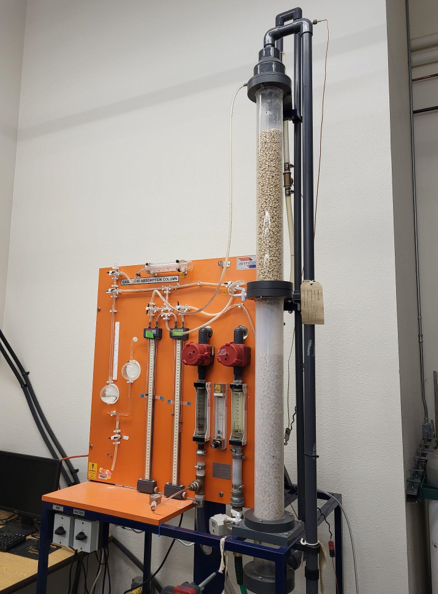 Pilot scale laboratory absorption column with controls for flow rates and manometers for measuring the pressure drop across each sub-column. Source: Seth Price
How does a gas-liquid absorption column work?
Gases can be dissolved into a solvent, such as water. This is how fish breathe (they still breathe air), and this is how oxygen is transported to cells in the human body. Gas-liquid absorption columns take advantage of this effect by encouraging an undesirable gas to dissolve into a liquid, as a liquid can be handled more easily, or because the liquid can be sold instead of released into the atmosphere.
In order to maximize the absorption, the interface between the liquid and gas must be maximized. Often, the gas stream is injected into the bottom of a vertical column and the solvent flows down through the column. This provides cross-flow and some turbulence to increase the absorption. Furthermore, the column is packed with small pieces that are wetted by the solvent, where a thin film spreads across the surface of each piece, increasing the surface area. The increased surface area increases absorption.
Column packing
Column packing can be in the form of small plates, raschig rings (small hollow cylinders), berl saddles and other small shapes. The key is to increase surface area and so the more surface area per volume, the more effective the packing. Furthermore, the packing must be able to be wetted by the solvent. If the solvent beads up with a low contact angle on the surface of the packing, it will not absorb as much gas as if the solvent can coat the surface.
Often, the packing material will be made from an unglazed ceramic with a complex geometry. Ceramic glazes will reduce the wetting, but sometimes are applied to reduce corrosion. Metals are rarely used for packing materials due to corrosion issues.
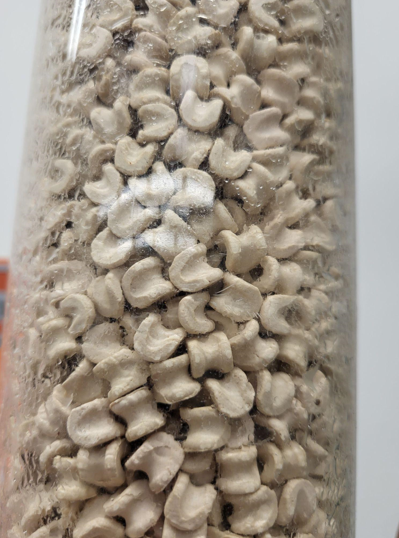 These tiny berl saddles help increase the surface area, which greatly increases the absorption. Source: Seth Price
Another consideration is the life of the packing material. Because these pieces are often small, with thin dimensions, high pressure or high flow rates can cause them to crash into each other, breaking them. Furthermore, depending on the chemistry of the materials, they are subject to damage from corrosion.
Control and design of absorption columns
In general, the standard gas-liquid absorption column has two important inputs: the gas stream and the liquid solvent. The gas stream may not be a variable that is controllable, as it may result from another process, but the liquid solvent flow rate can often be controlled. Besides the two inputs, the absorption column physical properties have a large influence on the effectiveness of the absorption.
The liquid solvent flow rate should be tailored to maximize the absorption of the gas into the solvent. In order to understand how the absorption is occurring, there are several methods of measuring the quantity of gas in the solvent. Directly, the gas stream can be monitored by a spectrophotometer. Indirect monitoring of pH, conductivity and other methods can be used to monitor the solvent. From there, a mass balance can be constructed to find how much gas was removed from the waste stream.
The temperature of the streams impact the absorption as well. The warmer the streams, both solvent and gas, the less absorption is possible. This is because the atoms are moving more quickly, meaning they are more likely to jump out of solution and back into the vapor phase. The temperature of the streams can be controlled using heat exchangers, but a careful cost analysis should be conducted beforehand to ensure that the additional absorption is worth the cost of purchasing and maintaining the heat exchangers.
Pressure drop across the column should also be monitored carefully. The pressure drop across the column shows how well material is flowing through the system. As packing material settles, the pressure drop will increase. This can reduce the flow rate, which can reduce the effectiveness of the absorption. Furthermore, the reduced flow rate can potentially back up the system, where solvent is accumulating, wearing out pumps or causing leaks.
Besides natural settling of the packing, other sources of reduced flow are due to broken packing material, which is able to fit in between the undamaged packing material. Also, contaminants from the vapor stream or the solvent stream can collect on the packing material. While chemical solvents are often pure, when water is used it should be filtered before entering the system. Some vapor streams have compressed air added to them. If this is the case, inline filters, oil traps and moisture traps should be used to prevent compressor oil from entering the column. Compressor oil can contaminate the packing, which can reduce the wetting of the packing material’s surface.
[Learn more about separation equipment on GlobalSpec.com]
Summary
Gas-liquid absorption columns are one tool for cleaning up waste streams. The process relies on increasing the surface area of the solvent to allow more room for vapor to absorb into the liquid. The end result is a solvent containing a higher quantity of the offending vapor, cleaning up the gas stream.
While it seems like a win-win to turn a waste stream into a marketable product, careful financial analysis is required. Often the recovered solvent stream is not a lucrative income stream, but instead reduces waste disposal costs, with a few bucks on the sale of the enriched solvent.