A bio-based method for rare Earth recovery
S. Himmelstein | February 15, 2022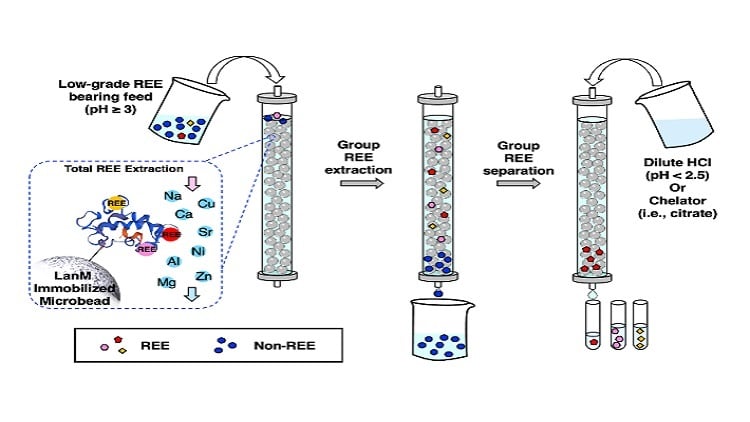 Schematic of the process for recovering rare earth elements from industrial waste or other feedstock. Source: Dong et al. 2021, ACS Central Science
A beneficial link between bacteria and the rare Earth element supply chain has been forged by researchers from Pennsylvania State University and U.S. Lawrence Livermore National Laboratory (LLNL). A protein isolated from bacteria was demonstrated to aid in the development of an environmentally friendly way to extract these metals and to separate them from other metals and from each other. The bio-based method could eventually be scaled up to help develop a domestic supply of rare Earth metals from industrial waste and electronics due to be recycled.
The bacterial protein lanmodulin, highly effective in binding to rare Earth elements, is immobilized onto commercially available agarose microbeads within a column to which liquid source material is added. The protein binds to the rare Earth elements in the sample, which allows only these metals to be retained in the column. The metals are freed from the protein and can be collected by altering acidity or other conditions in the system, and individual elements can be separated by changing the conditions in specific sequences.
The process described in the journal ACS Central Science was demonstrated to separate yttrium from neodymium, abundant elements in primary rare Earth deposits and coal byproducts, with greater than 99% purity. Neodymium was also separated from dysprosium, commonly present together in electronic waste, with greater than 99.9% purity in just one or two cycles.
“The high-purity of the recovered neodymium and dysprosium is comparable to other separation methods and was accomplished in as many or fewer steps without using harsh organic solvents,” said LLNL researcher Ziye Dong. “Because the protein is able to be used for many cycles, it offers an attractive eco-friendly alternative to the methods currently used.”