3D Printed Airplane Partition Is 45% Lighter
Engineering360 News Desk | December 02, 2015Airbus has developed a 3D-printed airplane cabin partition that is 45% (30 kg) lighter than current designs. The design could yield fuel and emission savings if it is incorporated into the next generation of the company's aircraft.
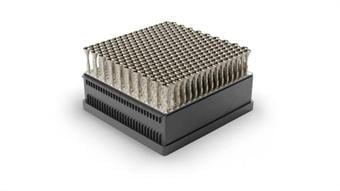
The “bionic partition”—a collaboration with 3D design and engineering firm Autodesk—was created with a micro-lattice design mimicking cellular structure. Produced using additive manufacturing techniques, this process renders the structure stronger and lighter than would typically be possible using traditional methods, according to Autodesk.
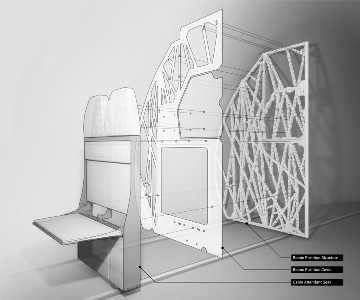 The partition was created with a micro-lattice design mimicking cellular structure. Image credit: Autodesk.Airbus estimates that, if applied to the entire cabin and to the current backlog of A320 planes, the design approach could save up to 465,000 metric tons of carbon dioxide emissions per year.
So-called "generative design" uses the cloud to compute large sets of design alternatives to meet specific goals and constraints, and in the process explore potential solutions that might not otherwise have been considered. Because the resulting designs are nearly impossible to manufacture using traditional methods, techniques like 3D printing are essential to the process.
The bionic partition was designed as the dividing wall between the seating area and the galley of the plane. Like many such structural components on an aircraft, the wall has specific design and structural requirements, including cutouts and weight limits, making the generative design approach particularly appropriate.
The design also represents one of the first large-scale uses of Scalmalloy inside an aircraft component. A second-generation aluminum-magnesium-scandium alloy intended for use in 3D printing, Scalmalloy is engineered to stretch more before breaking.
The first phase of testing of the partition has been successfully completed, the developers say. Further testing, including a test flight, will be conducted next year.