Infrared Laser Used to Cool Water
Engineering360 News Desk | November 26, 2015University of Washington scientists have used an infrared laser to refrigerate water—a discovery that could help industrial users “point cool” tiny areas with a focused point of light.
To achieve the breakthrough, the UW team—led by Peter Pauzauskie, assistant professor of materials science and engineering—used a material commonly found in commercial lasers but essentially ran the laser phenomenon in reverse. They illuminated a single microscopic crystal suspended in water with infrared laser light to excite a glow that has slightly more energy than that amount of light absorbed.
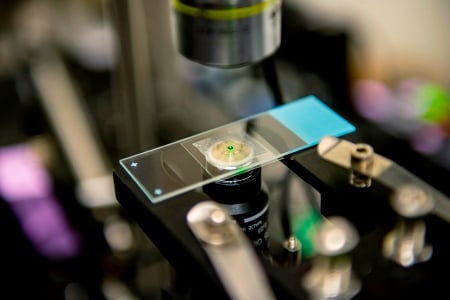 As they are cooled by the laser, the nanocrystals emit a reddish-green “glow” visible to the eye. Image credit: Dennis Wise/UW.This higher-energy glow carries heat away from both the crystal and the water surrounding it. The laser refrigeration process was first demonstrated in vacuum conditions at the Energy Department’s Los Alamos National Laboratory in 1995, but has taken nearly 20 years to demonstrate the process in liquids.
Typically, growing laser crystals is an expensive and time-consuming process. The UW team demonstrated that a low-cost hydrothermal process can be used to manufacture a well-known laser crystal for laser refrigeration applications in a faster, inexpensive and scalable way.
The UW team also designed an instrument that uses a laser trap—akin to a microscopic tractor beam—to “hold” a single nanocrystal surrounded by liquid in a chamber and illuminate it with the laser. To determine whether the liquid is cooling, the instrument also projects the particle’s “shadow” in a way that allows the researchers to observe small changes in its motion.
As the surrounding liquid cools, the trapped particle slows, allowing the team to observe the refrigerating effect. They also designed the crystal to change from a blueish-green to a reddish-green color as it cools, like a built-in color thermometer.
So far, the UW team has only demonstrated the cooling effect with a single nanocrystal, as exciting multiple crystals would require more laser power. The laser refrigeration process is currently quite energy intensive, and future steps include looking for ways to improve its efficiency.
According to the researchers, the cooling technology might one day be used to enable higher-power lasers for manufacturing, telecommunications or defense applications, as high-powered lasers tend to overheat and melt.
Microprocessors also could someday use a laser beam to cool specific components in computer chips to prevent overheating and enable more efficient information processing.
Scientists could also use a laser beam to cool a portion of a cell as it divides or repairs itself, essentially slowing these rapid processes and giving researchers the opportunity to see how they work. Or they could cool a single neuron in a network—essentially silencing without damaging it—to see how its neighbors bypass it and rewire themselves.