Printer Generates PCB Prototypes
Engineering360 News Desk | November 19, 2015A laptop-sized printer that generates circuit board prototypes in hours rather than weeks has earned its inventors the 2015 James Dyson international design award.
As printed circuit boards (PCBs) are the electronic paths that help power smartphones and many other electronic devices, it is essential for engineers developing these products to be able to prototype PCBs cheaply and quickly. However, this process can be time consuming and expensive.
The Voltera V-One, created by four graduates of the University of Waterloo in Canada, uses the same rapid prototyping principles that underpin 3-D printing to turn design files into prototype boards. Doing so saves electronic engineers from having to send their designs to fabrication houses for printing.
 Developers can turn design files into circuit boards with the press of a button. Image credit: Voltera."Even in Shenzhen, China, the electronics capital of the world, it took about three to four days to get a circuit board after sending it off for design," says Katarina Ilic, one of the developers behind the Voltera V-One. "You'd get the board back, another iteration is realized, and the entire process is started all over again."
Ilic, together with fellow engineers Alroy Almeida, James Pickard and Jesús Zozayathe, spent two years improving the electrical properties of conductive nano-silver ink. They produced a compact electromechanical system to dispense the thick ink and developed a software algorithm to control it.
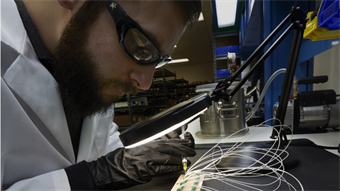
With the Voltera V-One, developers can turn design files into circuit boards by placing a blank template into the machine, uploading their Gerber file, pressing a button and then watching as a layer of conductive ink is printed on the board.
Two-layer circuit boards can be created by swapping out the conductive ink with insulating ink. Insulating overlays are printed wherever there is a crossover on the two layers of the board. After the insulator is printed and cured, the printer head is replaced and a second layer of conductive ink is printed.
Voltera V-One is also a solder paste dispenser, allowing components to be added to the board and reflowed by a 550w heater.
As winners of the James Dyson Award, the team will be awarded $45,000, which they plan to use to enhance testing and ramp up production of the printer, which is expected to ship in 2016.