Renewable diesel process delivers high yields from bio-feedstocks
S. Himmelstein | September 07, 2021New process technology from ExxonMobil Catalysts and Licensing LLC converts renewable feedstock such as vegetable oils and animal fats into renewable diesel fuel.
Hydrotreating and dewaxing are controlled separately in the two-stage ExxonMobil Renewable Diesel (EMRD) process. Compared to a single-stage system, this approach provides higher diesel yields and superior control and affords the potential to produce jet fuel as a secondary product with added fractionation.
A separate hydrotreating step enables better control, optimization and flexibility compared to a single stage process, with the ability to remove contaminants before the dewaxing catalyst. Use of a proprietary bio-dewaxing catalyst provides refiners and biofuel producers with powerful dewaxing in both winter and summer modes. Improved yields were demonstrated during testing of the catalyst versus other internally formulated zeolite-based alternatives.
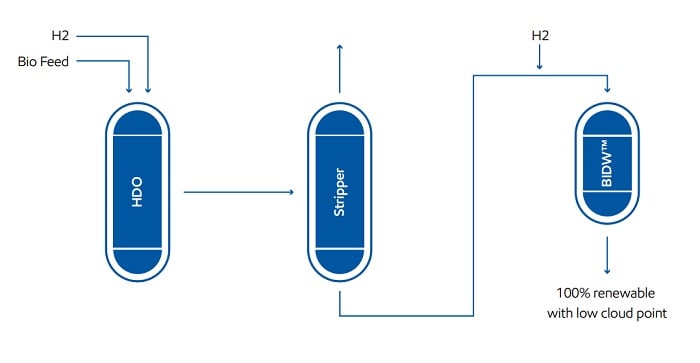 Schematic of the EMRD process. Source: Exxon Mobil Corporation
According to the company, the EMRD process offers a range of benefits that can help refiners enhance renewable diesel production while helping to meet stringent seasonal product specifications.