Video: Orbital solar power tech pursued by US Air Force
S. Himmelstein | July 12, 2021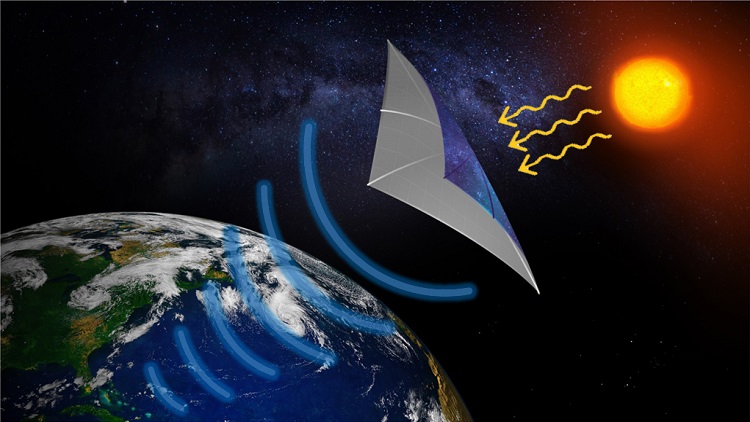 The image depicts SSPIDR beaming solar power from space to Earth. Source: AFRL
Technology to harvest solar energy in space and beam it down for use on Earth is being advanced by the U.S. Air Force Research Laboratory (AFRL). The Space Solar Power Incremental Demonstrations and Research (SSPIDR) project is developing a solar power transmission system for providing reliable power to expeditionary forces.
Flight experiments are being designed to mature different critical technologies needed to build an operational solar power beaming system in space. The SSPIDR project team has examined requirements for an operational prototype and identified five critical technologies needing further development to make this system a reality: deployable structures, energy generation, thermal systems, radio frequency beaming and metrology.
Satellites with large solar panels are envisioned to collect solar radiation, convert it on-board to microwaves or optical waves and beam that energy to rectennas for distribution. The planned Arachne satellite experiment based on the Helios bus provided by Northrop Grumman Space Systems will carry various day-to-day operating systems and the Space Solar Power Radio Frequency Integrated Transmission Experiment (SSPRITE) payload designed to demonstrate solar energy collection. SSPRITE will consist of an array of sandwich tiles engineered to consolidate the process of energy collection, conversion and beaming into a single unit.
Additional resources are allocated for evaluating array support structures and testing materials that can withstand the wide temperature swings in the outer space environment. In-orbit demonstrations are planned for 2024.