Watch this control concept drive electric motor efficiency
S. Himmelstein | May 24, 2021Propulsion technology developer Tula Technology Inc. has confirmed that its Dynamic Motor Drive (DMD) product mitigates efficiency losses of electric motors while significantly reducing reliance on rare-earth materials.
Application of this solution to electric vehicle (EV) motors has the potential to increase range while using less energy. Electric motors equipped with rare earth magnets can exceed 90% efficiency at peak performance, but real-world driving conditions often reduce motor efficiency to approximately 70% to 85%, far below the peak. The patented DMD pulse-density strategy mitigates efficiency losses through improvements in control software.
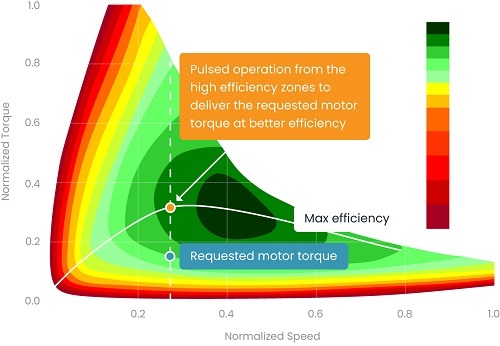 When torque requests are low, DMD operation pulses the magnetic field at optimal efficiency (orange); in conventional continuous motor operation, the efficiency is low at low torque (blue) for the same speed of operation. Source: Tula Technology Inc.Simulations of the DMD concept project efficiency improvements of 2.5% on the Worldwide Harmonized Light Vehicle Test Procedure (WLTP) cycle for an average EV. These improvements increase driving range while lowering total energy consumed.
DMD is cost-effective, software-driven and does not require hardware changes to the motor or vehicle. Additionally, DMD avoids many of the rare earth material challenges including escalating future costs, limited supply and sourcing risks.
The company previously developed Dynamic Skip Fire (DSF) as an advanced cylinder deactivation control strategy that has been shown to significantly reduce carbon dioxide emissions in gasoline engines. A diesel application of DSF has also demonstrated CO2 emission reductions of 5% and nitrogen oxide emission reductions of 74% in a Class 8 truck operating in a low-load cycle.
DMD uses the same pulse-density concept of DSF and applies that to electric motors and systems. In response to a requested motor torque demand, the DMD algorithms operate intermittently at the torque which has the maximum efficiency. When torque requests are low, the magnetic field is pulsed at optimal efficiency whereas in conventional motor operation, the efficiency is low at low torque.