Bacteria detection device could make cleaner food processing plants
Siobhan Treacy | May 11, 2021Researchers from Cornell University and 3M Company found that swiping surfaces in food processing plants with a specially designed rapid testing adenosine triphosphate (ATP) device could help diminish spoilage and foodborne illness.
During food production, routine cleaning and surface sanitation are key to preventing microbial contamination in food products. Without a healthy sanitation regime, food can be vulnerable to spoilage which puts people at risk of illness or death. Visual inspection is not a reliable indicator of how clean a surface is. Food processing plants often have small crevices and areas where microorganisms can grow.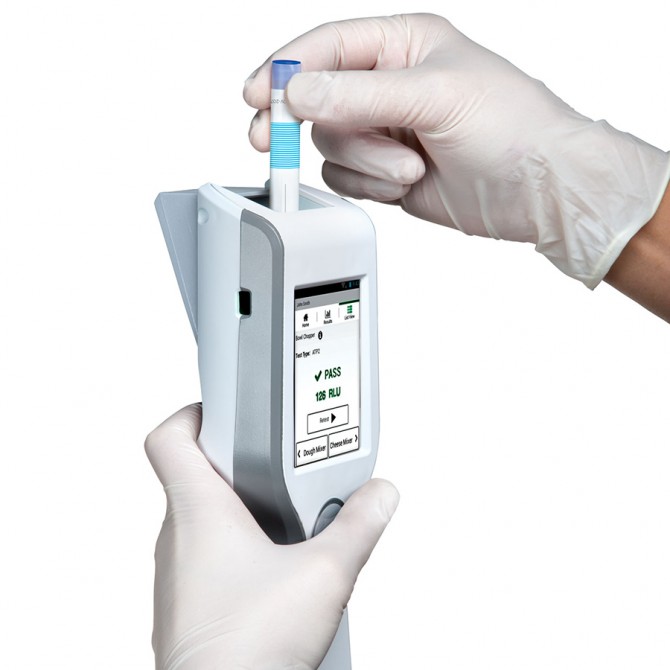 A food safety professional uses the 3M Clean-Trace luminometer to read a swab. Source: Cornell University
Every year 48 million Americans get sick from foodborne pathogens. Of that 48 million, 120,000 are hospitalized and 3,000 die, according to the U.S. Centers for Disease Control. Thorough and effective cleaning is key to keeping people safe from food-based illnesses.
The team spent nine months testing samples collected from a processing environment in a commercial tofu manufacturing facility. They examined the efficacy of an environmental monitoring program with a 3M Clean-Trace Hygiene Monitoring and Management system for ATP monitoring and 3M Petrifilm Plates for microbiological enumeration.
The team created a custom-designed plan using the ATP swab test to check dozens of critical points in the plant after it had been cleaned. After use, the ATP swab was placed in a luminometer instrument that detected the bioluminescence of contaminants. Light is transformed into relative light units and the value is displayed on the instrument. If the value exceeds a defined threshold value, the surface would be considered dirty and may indicate that cleaning is not done properly.
The results showed that targeted cleaning can improve the environmental hygiene of food processing facilities. This was demonstrated by the ATP monitoring and verified by further microbiological tests.
Using a luminometer in inspections would remove bias. On their own, an inspector’s bias may affect their review. But by using a device, the cleaning crew can see for themselves how effective their cleaning is. This is good for the facility and the product quality.
A paper on this research was published in Environmental Microbiology.