How to reduce runoff from logging operations
S. Himmelstein | April 07, 2021An experiment to study the impacts of logging in the Mica Creek watershed above the St. Joe River in Idaho was initiated 30 years ago. Researchers from Washington State University and University of Idaho used this historical dataset to develop a tool that could help timber operations choose the best areas to log to prevent flooding in downstream areas.
Timber harvest impacts water runoff, water quality and downstream flooding and can alter the frequency and magnitude of flooding. In agriculture, relatively small changes in farming practices have been observed to exert an outsized impact on preventing erosion problems. For instance, practices such as reducing tillage 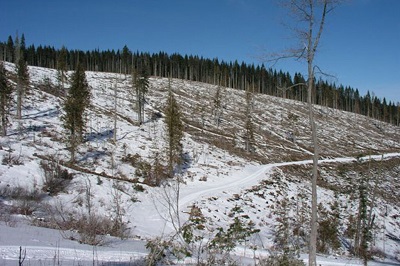 A research plot established in 1991 was used to study the effect of logging practices on runoff control and erosion. Source: Washington State Universityor plugging gullies at their source can prevent up to 50% of soil erosion problems.
The researchers analyzed timber and forestry with the same lens as for agricultural areas to find critical source areas that might cause an outsized impact on downstream flooding. A modeling scheme applied to the long-term watershed data revealed that logging operations could cut peak flows up to 40% by thinning instead of clearcutting, and that logging in critical source areas could lead to greater flooding.
In undisturbed forests, water infiltrates the ground, replenishes groundwater and feeds back into streams. Trees function as giant pumps, sucking up water from soil and releasing it through evaporation and transpiration in a cycle that dampens the effect of large storms and minimizes flooding. Once trees are removed, the soil stays much wetter and cannot provide sufficient storage for snowmelt or rain, resulting in increased runoff.
Soil saturation was shown to increase by 20% after timber harvesting, resulting in a higher risk of flooding after large rainfall events. Clearcutting on south-facing slopes at medium elevations strongly increased the average melt rate, leading to potential flooding as temperatures rise and snow melts. Thinning instead of clearcutting can reduce peak flow amounts significantly.
The research is published in the Journal of Hydrology.