Material both detects and removes atmospheric ozone
S. Himmelstein | February 10, 2021Ground-level ozone is a harmful air pollutant that can cause varying levels of health problems, such as lung damage. Techniques and devices developed to monitor or remove ozone suffer from high energy consumption and low selectivity, prompting researchers from Nankai University, China, to develop a material that can both detect and remove the pollutant.
The material is synthesized with highly crystalline covalent organic frameworks based on aromatic ring systems in a 3D structure with imines as connective groups. A rapid color change from yellow to orange or 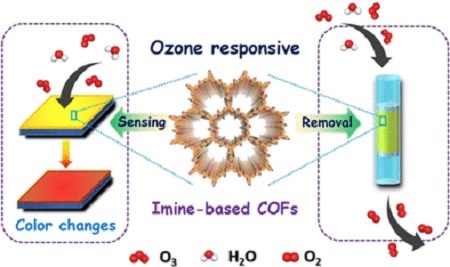 The material selectively indicates the presence of ozone and also renders the gas harmless. Source: Dong Yan et al./Angewandte Chemiered signals the presence of ozone in a sensor design that performs efficiently at high humidity and over a wide temperature range.
Water molecules present in the atmosphere preferentially bind to the imine groups, inducing the release of hydroxide ions, which react to ozone and cause the color change. If more ozone than water is present, or if the air being tested is dry, excess ozone binds to the imine groups and splits them so that each imine group degrades two molecules of ozone. This also causes a color change and the crystalline structure slowly begins to collapse.
The material was demonstrated to reduce ozone concentration below the 0.1 ppm recommended safety limit for humans.
A paper on this research is published in Angewandte Chemie.