Bacterial protein bolsters biosolar cell performance
S. Himmelstein | January 12, 2021A photosynthesis protein derived from cyanobacteria was used to produce a semi-artificial electrode that can convert light energy into other forms of energy such as hydrogen. The protein complex photosystem I was used by researchers from Ruhr University Bochum, Germany, and Universidade Nova de Lisboa, Portugal, to design electrodes for biosolar cells.
The electrodes for the solar cells were first encased in a photosystem I monolayer. In the cyanobacterium Thermosynechococcus elongatus, photosystem I exists mainly as a trimer, with three photosystems linked 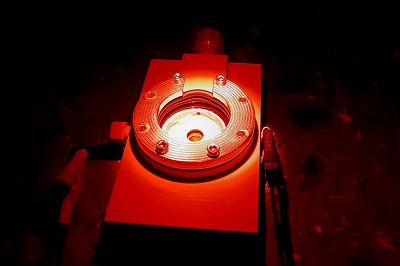 A bioelectrode with the protein complex photosystem I under irradiation with red light for measurement of the photocurrent response. Source: Felipe Conzuelo/Ruhr University Bochumtogether. The monolayer approach resulted in short circuits as the photosystems could not be stacked and resulted in structural gaps. A new extraction technique was developed to isolate additional monomers from the cyanobacteria for use in filling the holes between the trimers. The short-circuit effects were reduced and the re-engineered system achieved current densities twice as high as a system consisting only of trimers.
A mixed monolayer composition with the highest performance of photocurrents of about -2.0 μA/cm2 was selected for further experiments. When coupled with a hydrogenase enzyme, the electrode was demonstrated to produce hydrogen using electrons provided by the photosystem.
Development of a more efficient coupling between the photosystem monolayer and the integrated biocatalysts is expected to yield a practical biosystem for solar energy conversion.
A paper on this research is published in the journal Angewandte Chemie.