Graphene material powers efficient supercapacitors
S. Himmelstein | January 06, 2021Combing graphene with a metal-organic framework (MOF) produces a highly porous and conductive electrode for supercapacitors that could challenge some battery technologies in terms of specific energy capacity.
The basis of the newly engineered energy storage device is a novel, powerful and sustainable graphene hybrid material with a power performance comparable to that delivered by currently utilized batteries. The material consists of graphene acid, a surface-modified form of graphene that has carboxyl groups on its surface, and a 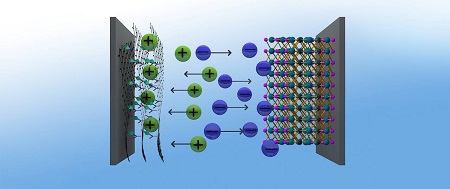 Graphene hybrids (left) made from MOFs and graphenic acid make an excellent positive electrode for supercapacitors. Source: Indian Institute of Technologyzirconium-based MOF that can covalently peptide bond to the graphene form.
The hybrid material with a total porosity of 780 m2/g was used to assemble a positive electrode, and an opposing electrode was fabricated with 2D MXene titanium carbide. The supercapacitor delivered ~73Wh/kg energy density at 1 kW/kg power density, or 32 Wh/kg energy density at 16 kW/kg power density, compared with 30 Wh/kg — 55 Wh/kg for rechargeable lithium batteries, 30 Wh/kg — 45 Wh/kg for lead‐acid batteries and 60 Wh/kg — 120 Wh/kg for nickel metal hydride batteries. The device also performed much better than most other supercapacitors at a power density of 16 kW/kg. Energy capacity dropped with use to under 90% of its initial value after 10,000 cycles, although charge-discharge efficiency remained at ~100% throughout.
A paper on the research conducted by scientists from Indian Institute of Technology, Queensland University of Technology (Australia), Technische Universität Dresden (Germany), Palacky University (Czech Republic), U.S. Sandia National Laboratories, Jawaharlal Nehru Centre for Advanced Scientific Research (India) and Technical University of Munich is published in Advanced Materials.