Watch: Road tire component implicated in salmon mortality
S. Himmelstein | December 07, 2020A majority of coho salmon migrating to urban streams in the Pacific Northwest perish before spawning. In some runs, mortality can be as high as 40% to 90% after stormwater runoff events. The culprit originates with road vehicles and has been identified as residues of a chemical shed by tires.
The preservative 6PPD, widely used to protect tires from ozone degradation, leaches out of the particles that tires shed onto pavement. Under ozone exposure, the compound transforms into 6PPD-quinone, the toxic 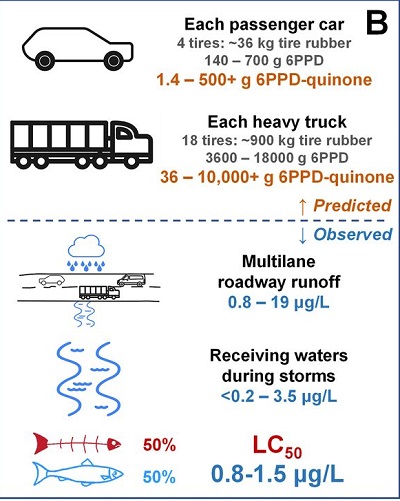 Predicted ranges of potential 6PPD-quinone mass formation in passenger cars and heavy trucks, (represented in orange) and measured 6PPD-quinone concentrations in affected environmental compartments (represented in blue). Source: Zhenyu Tian et al.chemical that is responsible for killing the salmon. Researchers had established that environmental samples contained a chemical signature associated with tire wear particles and that a solution containing these materials was highly toxic to salmon. The real work was in singling out the causative agent from the numerous chemical constituents comprising the particles.
Researchers sectioned tire wear particle solutions according to different chemical properties, such as removing all metals from the solution, which were then then assayed to identify which ones were still toxic to salmon in the lab. The process was repeated until only a few chemicals remained, including one that appeared to dominate the mixture but did not match anything known. A survey of U.S. Environmental Protection Agency data and industry literature helped to narrow down the identity of the toxicant. The transformation product, 6PPD-quinone, was finally characterized as the fish-killing pollutant in urban runoff.
Improved management of 6PPD-quinone discharges by means of treatment strategies, regulatory measures and chemical additive substitution is suggested in the study published in Science. Scientists from the University of Washington, Washington State University, the University of Toronto, Southern California Coastal Water Research Project, San Francisco Estuary Institute, U.S. National Marine Fisheries Service and U.S. Fish and Wildlife Service contributed to this research.