Watch: Low cost inflatable pump designed to harness wave energy
S. Himmelstein | November 23, 2020A prototype design for a novel wave energy converter invented in the garage of a U.S. National Renewable Energy Laboratory (NREL) researcher is now being patented. The inflatable wave pump is assembled with low cost, flexible materials to absorb wave energy through the varying hydrostatic and hydrodynamic pressures at or below the water’s surface.
Use of rubber, rubber-coated fabrics and other inexpensive materials to construct the converter may translate into reduced requirements for marine-resilient coatings typically associated with steel or composite structures.
The inflatable wave pump can function as a constant-volume system that transfers energy in the form of air 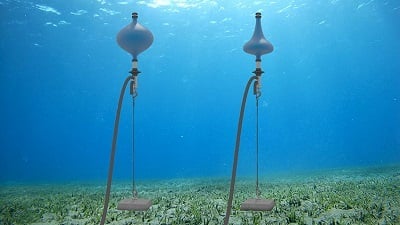 The inflatable wave pump design could lead to affordable wave energy. Source: Josh Bauer, NRELpressure into a diaphragm-type positive displacement pump with a spring that is used to provide a restoring force. As a wave passes over the submerged device, it compresses the air chamber, which expands the diaphragm which in turn pushes and pulls water through a series of check valves to fill the pump chamber. As the pressure in the chamber is reduced, the spring restoring force from the diaphragm pushes air back into the air chamber and the cycle continues. Alternatively the wave pump may have an air chamber that drives a piston, bellow, turbine or linear generator.
Lighter in weight and volume than many other wave energy converters, the inflatable wave pump structures can be more easily transported on land or by ship to a final deployment location. The system design supports use of load-shedding techniques not possible with rigid-body wave energy converters such as pressure releases via relief valves used during extreme wave conditions. Flexible load shedding can reduce the required design loads and lower the cost of structural assemblies. The flexible bellow design also eliminates the need for mechanical seals, a common failure mode for fluid power systems, and instead relies on longer service life static seals.